

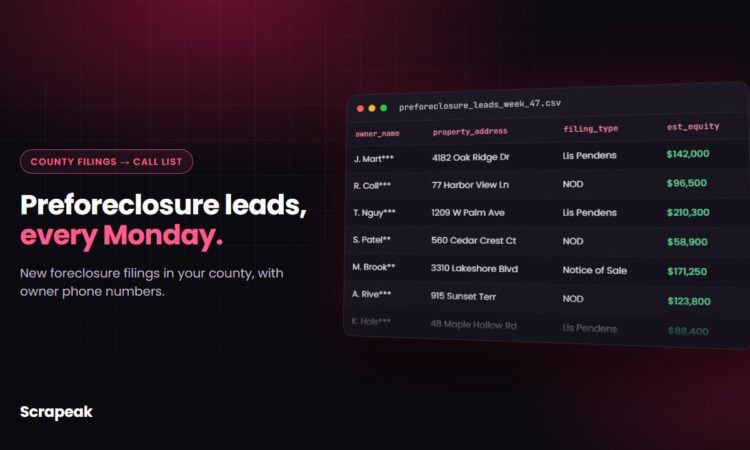
Every homeowner who falls behind on a mortgage leaves a paper trail at the county. The investors who get those deals are rarely the ones with the best scripts. They’re the ones who see the filing first and reach the owner while there’s still time to help.
The good news is that the paper trail is public. The bad news is that collecting it by hand eats your week. Here’s a routine that gets you a fresh preforeclosure list every Monday, and where you can stop doing the boring parts yourself.
Where preforeclosure leads come from
A preforeclosure lead starts with one document recorded at the county. Which document depends on your state.
- Notice of Default (NOD) in non-judicial states like California or Arizona. The lender records it and the foreclosure clock starts.
- Lis pendens in judicial states like Florida, New York or Illinois. It’s a notice that a lawsuit affecting the property has been filed.
- Notice of Trustee Sale or Notice of Sale, the later-stage filing that sets an auction date.
You’ll find these in three places: the county recorder or clerk’s online records search, the clerk of court’s docket (in judicial states), and the legal notices section of the local newspaper. Some counties put everything online. Others still make you search one name or one date at a time.
If you’re new to the process itself, USA.gov’s foreclosure page is a decent plain-language overview of what the homeowner is going through. Worth reading before you call anyone.
The weekly routine
This is the routine we’d set up for an investor working two or three counties. It takes about an hour a week once the data side is handled.
1. Pull last week’s filings
Search each county for NODs or lis pendens recorded in the last seven days. Export what you can. For each filing you want the owner name, property address, recording date, document type, lender and, if it’s listed, the amount in default.
This step is where most people quit. One county with a clunky search can take an afternoon. Three counties, every week, and it becomes a part-time job.
2. Throw out the dead ends
Not every filing is a lead. Remove commercial properties, filings that were already rescinded, and anything with an auction date too close to do something useful. A list of 120 filings often shrinks to 60 or 70 real prospects, and that’s fine. You’d rather call 60 good leads than 120 mixed ones.
3. Check equity before you spend a dime
A homeowner who owes more than the house is worth can’t sell to you, no matter how motivated they are. Compare the estimated value against what’s owed. Public listing data helps here: a Zillow data pull gives you estimated values and recent sales for the same addresses, so you can sort by likely equity instead of guessing.
4. Find a way to reach the owner
Filings give you a name and a property address. They don’t give you a phone number, and the owner may not even live at the property. This is where skip tracing comes in: matching the owner to current phone numbers, emails and mailing addresses.
Scrapeak’s People Search scraper does exactly this, either from the web dashboard or through the API if you want it wired into your CRM. Each search costs 100 credits, and new accounts start with 1,000 free credits, so you can test it on ten of this week’s leads before paying anything.
Try skip tracing on your own list. Upload a few of this week’s owners and see what comes back. Start free with 1,000 credits, no credit card needed.
5. Reach out, then follow up
Mail goes to the property and to any other address you found. Calls go to the numbers that came back from skip tracing. Then follow up, because a first touch almost never closes a preforeclosure deal. Owners in default get a lot of mail, and most of it sounds the same. A short, honest letter that explains their options tends to stand out more than a glossy “We buy houses” flyer.
One caution: some states have specific rules for contacting homeowners in foreclosure, and phone outreach comes with do-not-call rules. Check yours with a local attorney before you start dialing.
What to automate (and what to keep)
Here’s how we’d split the work.
| Step | Do it yourself? | Automate? |
|---|---|---|
| Pulling filings from county sites | Only if you cover one small county | Yes, this is the biggest time saver |
| Cleaning and filtering | Your rules, your judgment | Partly (dedupe, drop commercial) |
| Equity estimates | Spot-check the top leads | Yes, with listing data |
| Skip tracing | No | Yes |
| Talking to the homeowner | Always you | Never |
Honestly, if you only work one county with a good online search, doing step 1 by hand is fine. Automation pays off when you add a second or third county, or when the county site makes you search one document at a time.
Getting county filings without the manual work
Every county website is different, which is exactly why off-the-shelf tools often skip the smaller ones. We build custom scrapers for this: you tell us which counties and document types you care about, and we deliver new filings on a schedule, daily or weekly, as a CSV, Google Sheet, or straight into your system through an API. Simple projects are usually ready in two to three days, and we maintain the scraper when the county changes its site.
If you’re curious how this works under the hood, our post on what web scraping is covers the basics, and this one shows other ways investors use it.
Want your counties’ filings in your inbox every Monday? Tell us which counties and filing types you need, and we’ll quote a scraper built for them.
FAQ
What’s the difference between preforeclosure and foreclosure?
Preforeclosure is the window between the first default notice and the auction. The owner still owns the home and can sell, refinance or catch up. Once the property goes to auction or back to the lender, it’s a foreclosure.
Are preforeclosure lists public record?
The filings are. NODs, lis pendens and notices of sale are recorded with the county, so anyone can look them up. What isn’t public is the owner’s phone number, which is why skip tracing is a separate step.
How long does preforeclosure last?
It depends heavily on the state. Non-judicial states tend to move faster, often a few months. Judicial states can take much longer because the case goes through the courts.
Is it better to buy a preforeclosure list or build my own?
Bought lists are quick to start with, but you share them with every other subscriber in your area. Building your own from county records takes more setup and gets you leads others may not have yet, especially in smaller counties that big data vendors cover poorly.
How often should I pull new filings?
Weekly is enough for most investors. In busy markets, some pull daily so they can reach owners within a few days of the filing.