

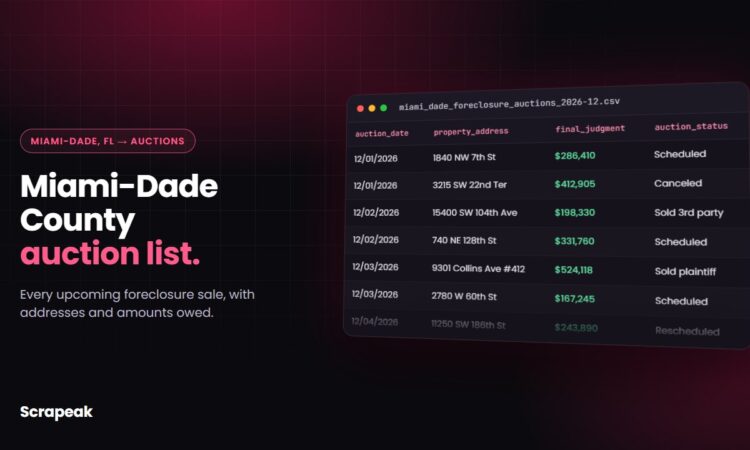
Every foreclosure sale in Miami-Dade happens on a website, usually while you’re busy doing something else. If you bid, wholesale or chase surplus funds here, the Miami Dade foreclosure auction list is the page you end up refreshing every morning.
The sales themselves are simple. Keeping track of them is the hard part. Dates move, cases get canceled the night before, and the result you care about (who bought it, for how much) shows up after the fact. Below is how the sales work under Florida law, what the list actually contains, and how to stop checking it by hand.
How the Miami Dade foreclosure auction works
The Clerk of the Court and Comptroller runs every mortgage foreclosure sale in the county. Miami-Dade moved these auctions off the courthouse steps and onto the web back in 2010, and today they run on the county’s RealForeclose site at miami-dade.realforeclose.com. You have to register there before you can bid.
Here’s the sequence for a typical case:
- The judge enters a final judgment of foreclosure. Under section 45.031 of the Florida Statutes, the sale date is set 20 to 35 days later, unless the plaintiff agrees to a later date.
- A notice of sale runs in a local paper twice. The second notice has to appear at least 5 days before the sale.
- On sale day, the winning bidder owes a deposit of 5 percent of the final bid. Because the sale is electronic, the clerk can require you to put that money on deposit before you bid.
- You pay the balance within the period set in the sale terms. Miss it and the clerk readvertises the sale and pays its costs out of your deposit.
- The clerk files a certificate of sale. Anyone with standing then has 10 days to object.
- No objections? The certificate of title issues and the sale is confirmed.
Take step 4 seriously. In Space Coast Credit Union v. Day (2019), the Third District Court of Appeal, which hears Miami-Dade appeals, reversed an order that had handed a third-party bidder his deposit back after he missed the final payment. The statute says the deposit covers the costs of the resale, and the court held the clerk to it. Have the money ready before you click.
The clerk’s own page adds two warnings. It does not guarantee clear title and isn’t responsible for liens that survive the sale, so run a title search first. And the homeowner can still redeem by paying the full judgment amount plus interest, fees and costs, up until the certificate of sale is issued (or as the final judgment says).
Tax deed sales are on the same site, under different rules
The Clerk’s Tax Deed Unit sells properties with unpaid property taxes on the same RealForeclose platform, under the clerk’s Administrative Order 13-05. The money rules are tighter. Under section 197.542, the high bidder posts a nonrefundable deposit of 5 percent of the bid or $200, whichever is more, and pays the rest plus documentary stamp tax and recording fees within 24 hours, not counting weekends and legal holidays.
The opening bid is what it would take to redeem the tax certificate, plus costs and interest. If the certificate holder doesn’t pay when due, the parcel goes on the “lands available for taxes” list, which the county publishes as a report. Anyone watching only the foreclosure calendar misses these.
One thing to keep separate: the Miami-Dade Sheriff also holds sales, and those have their own conditions, including a nonrefundable 10 percent deposit due right after the sale. Those aren’t on the clerk’s auction calendar.
What’s on the list
The auction calendar shows one day at a time. Once you pull every sale day into one file and join it with the court docket and the property appraiser’s records, these are the columns you can work with:
| Field | What it tells you |
|---|---|
| case_number | The circuit court case. You need it to read the docket and the final judgment. |
| auction_date | The scheduled sale date. It can move more than once. |
| sale_type | Mortgage foreclosure or tax deed. |
| property_address | Street address of the property being sold. |
| parcel_id | The folio number, which Miami-Dade uses to identify every parcel. It’s the cleanest way to match a sale to appraiser data. |
| final_judgment_amount | What the court says is owed. A rough ceiling for where the plaintiff will bid. |
| opening_bid | For tax deed sales, the starting price built from the certificate amount, costs and interest. |
| assessed_value | The appraiser’s value, useful for a first pass at equity. |
| plaintiff | Usually the lender, sometimes a condo or homeowners association. Worth a filter, since an association case can carry a much smaller judgment than a bank case. |
| auction_status | Scheduled, canceled, sold to the plaintiff or sold to a third party. |
| sold_amount | The winning bid. Compare it with the judgment to spot possible surplus. |
If you want to see these columns filled in for real upcoming Miami-Dade sales, ask us for a free sample and we’ll send one over.
Where the leads hide: surplus and the cases before the sale
The sold_amount column is where surplus shows up. When a third party outbids the judgment, the difference becomes surplus. Under section 45.032, the owner of record on the date the lis pendens was filed is presumed entitled to it, after subordinate lienholders who filed timely claims. One year after the sale, surplus still sitting with the clerk is presumed unclaimed.
The clerk’s page says owners can claim without a lawyer, should call the Foreclosure Unit within 10 days of the certificate of sale, and may owe a $50 reopening fee. If you help people recover surplus, check Florida’s rules on fees and agreements for surplus recovery with a local attorney before you reach out.
If you’d rather get in before the auction, go upstream. Every one of these cases started with a lis pendens, and the clerk’s official records search lets you look those up (recorded mortgages back to 1974 are online too). Our guide to building a weekly preforeclosure lead routine covers that side, and our People Search scraper finds current phone numbers and mailing addresses for the owners on either list.
Getting the list without the morning refresh
Checking the calendar by hand works for a week or two. Then it starts eating your mornings. You click into each sale day, open each case, copy the address and judgment into a spreadsheet, and then come back after the sale to see what happened. A case scheduled for next Tuesday might be canceled on Monday night, so the spreadsheet you built on Friday is already wrong.
The site doesn’t make this easier. RealForeclose pages are built for bidders clicking through one auction at a time, and automated visitors often get blocked.
We build and run scrapers for exactly this. For Miami-Dade we’d pull every scheduled foreclosure and tax deed sale, recheck statuses so cancellations and reschedules show up, capture results once sales close, and match each folio number to appraiser data. You get it as a CSV, a Google Sheet or through an API, daily or weekly. For an investor watching, say, 40 Hialeah and Homestead sales a week, that means opening one sheet over coffee instead of clicking through forty case pages.
We maintain the scraper when the site changes, and simple projects are usually ready in two to three days. If you also want Broward or Palm Beach, add them to the same feed.
Get a free sample of the Miami-Dade County foreclosure auction list
Tell us the county and list you need and we’ll send you a free sample, usually the same day. After that we can deliver it daily or weekly as a CSV, Google Sheet or API.
FAQ
Where can I see upcoming Miami-Dade foreclosure auctions?
On the county’s RealForeclose site, miami-dade.realforeclose.com, which the Clerk of the Court and Comptroller links from its mortgage foreclosures page. The calendar shows sales day by day. You need to register to bid, and you can review the court file for any property on the list.
How much deposit do I need to bid on a Miami-Dade foreclosure?
Florida law requires the winning bidder to post 5 percent of the final bid, and because sales are online, the clerk can require you to put those funds on deposit before you bid. Check the auction site for the current deposit rules before sale day.
What happens if I win and can’t pay the balance?
The clerk readvertises the sale and pays the resale costs from your deposit. The Third District Court of Appeal enforced that rule in a 2019 Miami-Dade case, so don’t count on getting the deposit back.
Are tax deed sales the same as foreclosure sales in Miami-Dade?
No. Both run on the same website, but tax deed sales come from unpaid property taxes. The deposit there is nonrefundable (5 percent or $200, whichever is more), and the balance is due within 24 hours, not counting weekends and holidays.
Can I get the auction list as a spreadsheet?
The county doesn’t offer an export, so most people copy it by hand. We can deliver every scheduled sale, with status and results, as a CSV or Google Sheet on a daily or weekly schedule. Ask for a free sample to see the format first.