

Almost everyone in Austin and the rest of Travis County pays their property taxes on time. In July 2026 the Tax Office said it had collected over 98% of 2025 tax-year property taxes. A Travis County tax delinquent list is the small group who didn’t, and that group is worth a lot to the people who can find it early.
The ones who ask us for it are HVAC and roofing companies, insurance agents, real estate agents, and investors. They all want the same thing: an address, an owner, the amount owed, and a heads-up before the property shows up at a tax sale. Here’s how delinquency works in Travis County, where the data actually sits, and how we scrape it into one sheet you can work from on Monday morning.
Who uses the Travis County tax delinquent list
HVAC, roofing and other home-service companies
An owner who is behind on property taxes is often putting off other bills too, and an aging AC unit or roof is easy to put off. If the house is sold at a tax sale or by the owner to clear the debt, the next owner tends to fix what was put off. A contractor who has the address first gets the first call.
Insurance agencies
Tax sale buyers in Travis County get the property “as is”, with a Constable’s Deed rather than a warranty deed, so they need a policy right away and sometimes a vacant or landlord policy. Owners who are refinancing or selling to pay off back taxes need a new quote too. A weekly list gives an agent a reason to call before a competitor does.
Real estate agents and brokers
Some owners sell before the county gets anywhere near a sale. Selling while there is still equity can beat losing the house at auction, and an agent who reaches them early can offer that option.
Investors and wholesalers
Investors use the list two ways. Some make offers to owners directly, months before a sale. Others watch which accounts reach the monthly tax foreclosure sale and bid there. Texas doesn’t sell tax lien certificates, so the deal is always the property itself.
Whatever you sell, outreach has to follow do-not-call lists, the TCPA, and the rules for your license. This is general information, not legal advice.
How property tax delinquency works in Travis County
The Travis County Tax Assessor-Collector bills and collects for nearly all the local taxing units in the county, so one office holds most of the delinquent balances. Taxes are due by January 31. On February 1 unpaid accounts become delinquent and the Tax Office adds 7% (6% penalty plus 1% interest). Its penalty and interest table shows the total climbing to 18% in July and 24% by the next January, with interest still adding 1% a month after that.
On July 1 state law can add one more charge. Under Texas Tax Code section 33.07, taxes delinquent before June 1 may pick up a penalty of up to 20% for collection attorney costs, where that applies. That July jump is a good reason to work the list in spring.
Homeowners with a homestead exemption can ask for a 12-month installment plan, which freezes the penalty rate as long as payments come in. Accounts that stay unpaid can end up in a tax suit, which the County Attorney’s Tax Collections Team files in state court on behalf of the Tax Office. Once a court orders a sale, the property goes to the monthly sale.
Those sales run through RealAuction on the first Tuesday of each month. The Tax Office’s foreclosed properties page lists the dates (the next one is December 1, 2026) and the rules. You register with both RealAuction and the Tax Office, pay a $10 fee at least five business days before the sale, and you can’t bid if you owe back taxes on any Travis County property. The minimum bid covers the taxes, penalties, interest, attorney fees and court fees for the years used to foreclose. After the sale, owners can still redeem: generally two years for a homestead or agricultural land and 180 days for other property, under Texas Tax Code section 34.21.
Want to see Travis delinquent accounts laid out as a spreadsheet? Ask us for a free sample.
Where the Travis County tax delinquent list data lives online, and why it’s hard to collect
There’s no single file to download. The data is split across four places, and each one was built for a person checking one property, not for anyone extracting thousands of rows. None of them has an export button, so a scraper has to do the collecting.
The Tax Office account search
is visible in the Travis County account search, but you look up accounts one by one, by owner, address or account number. It answers “what does this house owe?” and has no way to answer “which houses owe?” To build a list by hand you’d need a list of accounts to check in the first place. A scraper solves that by walking the search systematically and extracting every result into a dataset.
The appraisal records
, mailing addresses, property use and values come from the Travis Central Appraisal District. Those records are what turn a tax account into something you can mail or call, and they have to be matched to the tax data property by property.
The RealAuction sales list
days before each sale, the properties headed to auction appear on the Travis RealAuction site, with photos for lots that have buildings and an “Additional Taxes Due” figure for unpaid years outside the judgment. Properties can drop off before the sale, for example when the owner pays, so the list you copied on the 15th can be wrong by the first Tuesday. A scraper should check it again the day before the sale.
The newsroom lists
publishes a Top 10 list of the largest delinquent taxpayers each year, and in July 2026 it added a list of 20 delinquent aircraft owners. These make headlines, but they cover the biggest balances only, so scraping them won’t fill a lead list.
Copying from all four by hand instead of scraping them breaks in predictable ways. Paid accounts stay on your sheet because nobody rechecked them. The same owner shows up three times because they own three lots. A mailing address in another state gets missed, so the letter goes to an empty house. And the sale list changes after you copied it. For 30 properties a month, a spreadsheet and patience is fine. For the whole county, it’s a part-time job that’s never quite current.
Scraping the Travis County list: fields, schedule and delivery
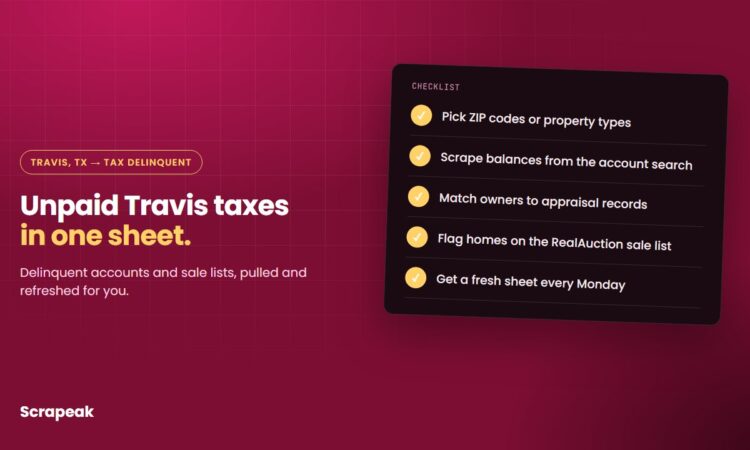
A scraper does the boring part on a schedule. It walks the account search for the properties you care about (a ZIP code, a property type, or the whole county), extracts each balance and tax year, joins the appraisal record, and checks the RealAuction sales list whenever a new one is posted. Each row in the dataset looks like this:
| Field | What it means |
|---|---|
| parcel_id | The appraisal district property ID. We deduplicate and join everything on it. |
| owner_name | Owner of record from the appraisal roll. |
| property_address | Where the property is, so you can filter by ZIP code or neighborhood. |
| mailing_address | Where the tax bill goes. Out-of-state mailing addresses often mean a landlord or an inherited house. |
| tax_year | Each unpaid year, listed separately. |
| amount_due | Base tax plus penalty and interest as of the scrape date. It rises every month, so the date matters. |
| years_delinquent | How many years are unpaid. One year is often an oversight. Three is a pattern. |
| assessed_value | Appraised value, for a rough equity check against the amount owed. |
| property_use | Homestead, rental, commercial or vacant land. Homesteads get the two-year redemption period. |
| sale_status | Whether the property is on an upcoming sales list, was struck off, sold, or was pulled before the sale. |
Keeping the list current takes more work than the first pull. We schedule a weekly run on the delinquent accounts, an extra pass when each RealAuction list is posted, and a check after the first Tuesday to record which properties sold and which were pulled. Change detection flags accounts that were paid so they drop off your call list, and new delinquencies show up at the top.
Delivery fits however you work: a CSV in your inbox every Monday, a Google Sheet that updates itself, an API, or files in S3, Dropbox or Google Drive. If you need phone numbers for the owners, our People Search scraper can add current contact details to each row.
Build your own scraper or get a Travis County data feed
If you only need one month’s sale list, do it by hand. Open the RealAuction list, copy it, done. A scraper starts paying for itself when you want every delinquent account in a few ZIP codes, refreshed every week.
Building it yourself means handling a search form that returns one account at a time, rate limits so you don’t hammer a county site, matching tax accounts to appraisal records, and a RealAuction calendar that changes up to the morning of the sale. Each site also changes its layout now and then, and every change breaks the scraper until someone fixes it. If Texas is only one of your states, compare it with a Florida county, where unpaid taxes become tax certificates first; our Miami-Dade foreclosure auction guide shows how different the sale data looks there.
Scrapeak builds and maintains the scraper for you. We pull the Travis sources, clean and deduplicate the rows, keep the schedule running when the sites change, and send the list where you want it. Simple projects are usually live in two to three days, and adding Williamson or Hays County later is the same feed with more rows. You see a free sample before paying for anything.
Get a free sample of the Travis County tax delinquent list
Tell us the county and list you need and we’ll send you a free sample, usually the same day. After that we can deliver it daily or weekly as a CSV, Google Sheet or API. Contractors, insurance agents, real estate agents and investors all work from the same feed.
FAQ
Does Travis County publish a list of delinquent property taxes?
Only in pieces. The Tax Office posts a Top 10 list of the largest delinquent taxpayers in its newsroom, and the sales list for each monthly tax foreclosure sale goes up on the Travis RealAuction site about 15 days before the sale. Individual balances are in the Tax Office account search, one account at a time. A full list across the county has to be assembled.
Does Travis County sell tax liens?
No. The Tax Office says it does not sell tax liens, and Texas does not sell tax lien certificates. Buyers purchase the property itself at the monthly tax foreclosure sale, which RealAuction runs for Travis County, and receive a Constable’s Deed, which is not a warranty deed.
How long can an owner redeem a property after a Travis County tax sale?
Under Texas Tax Code section 34.21, the owner of a residence homestead or land designated for agricultural use generally has two years to redeem, and most other property has 180 days. The redemption premium is 25% in the first year and 50% in the second. Ask a Texas attorney about a specific property.
Can roofers, HVAC companies or insurance agents use a tax delinquent list?
Yes. Home-service companies use it to find older homes whose owners may be deferring repairs or getting ready to sell, and insurance agents use it to reach owners and tax sale buyers who will need a new policy. Check do-not-call, TCPA and your own licensing rules before any outreach.
How often can the Travis County tax delinquent list be scraped and updated?
As often as the sources change. Most buyers take a weekly delinquent refresh plus an extra pull around each sale, when the RealAuction list is posted and again after the first Tuesday results. We deliver it as a CSV, Google Sheet or API feed.