

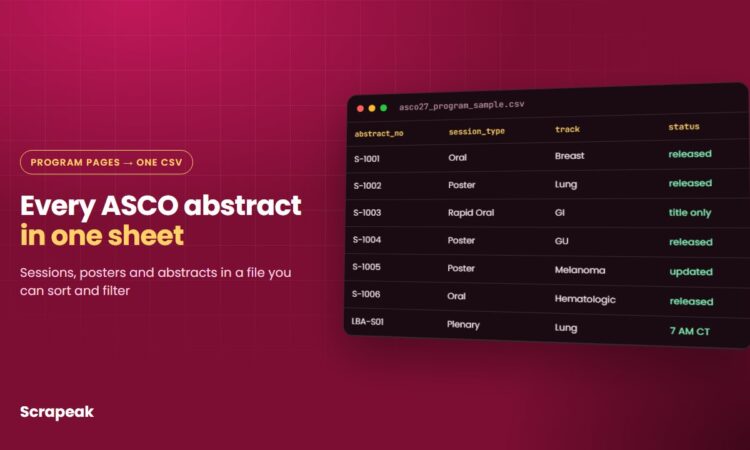
ASCO is in Chicago from June 4 to 8, 2027, and somebody on your team will be asked to turn the program into something the rest of the team can sort. The ASCO Annual Meeting abstracts are all public on ASCO’s own site, but they’re built for one oncologist searching one topic, not for a booth team, an events lead or a data analyst who wants every session, poster and abstract in one file.
This post walks through one team’s version of that request: what ASCO publishes and when, how a scraper builds the dataset, which fields to keep, and how to keep the file right through the last day of the meeting.
What ASCO publishes for the Annual Meeting, and when
ASCO puts the meeting online in stages, and the stage decides what your file can hold. These dates come from ASCO’s official “Dates to Know” page for 2027:
- January 26, 2027: abstract submission deadline (late-breaking submissions close March 8).
- Late April 2027: abstract titles, including late-breaking abstract titles, posted on meetings.asco.org.
- Late May 2027: the embargo lifts and most abstracts are released on asco.org/abstracts.
- June 4 to 8, 2027: the meeting itself. Late-breaking abstracts are released at 7:00 AM CT on the day they are presented.
So for about a month you can only work with titles and session slots. The full abstract text arrives a week or two before the meeting, and the late-breakers only show up on the day. ASCO even notes that full text may not display until shortly after the posted time while the site is under load.
The ASCO abstracts and presentations search covers abstracts, posters, slides and videos, with filters by meeting and content type. Search results show the title, first author, publish date and, for journal content, a DOI. Each abstract page adds the abstract number, the session it belongs to and the abstract text. Some presentation material, such as slides and videos, may need a sign-in.
One team’s request, walked through
Here’s a typical (illustrative) case. A marketing team at a company that sells oncology imaging equipment has a booth at ASCO and six people on the floor. In April their manager asks three questions: which sessions touch imaging or radiation planning, when are they, and which posters should someone actually walk past?
The first attempt is always the same. Someone opens the search, types a few keywords and copies results into a spreadsheet. It works for about forty rows. Then the problems pile up. The search loads results as you scroll, so the copy misses the bottom of the list. Session title, abstract number and author end up merged in one cell. Every abstract needs its own click. And in late May, when the full text drops, the sheet is out of date and the whole job starts again.
What the team actually needs is a dataset with one row per presentation, refreshed on a schedule, that they can filter by track, session type, day and keyword. That’s a scraping job, and a fairly predictable one.
Planning for ASCO 2027? Tell us the fields you need and how you’ll use the file, and we’ll send a free sample and a quote. Request a free sample
How a scraper turns ASCO Annual Meeting abstracts into a dataset
A scraper does the clicking for you, carefully and on a schedule. For ASCO the build usually goes like this.
- Find where the data really comes from. The ASCO search is a JavaScript app, so the HTML you see in “view source” is mostly empty. The results are loaded from background requests that return structured data. Reading those responses directly is faster and breaks less often than parsing the rendered page, and when that isn’t possible, a headless browser renders the page first.
- Walk the whole program. The crawler filters to the Annual Meeting, pages through every result for each content type, and follows each item to its detail page. It goes slowly and politely, because nobody wants to load a site that thousands of oncologists are using the same week.
- Pick the row shape. One row per presentation works for most teams, with the session details repeated on each row. If you need co-authors and institutions, they go in a second table linked by abstract number, instead of crammed into one cell.
- Clean it. Times are normalized to Central Time, session types get one consistent label, and duplicates are removed (the same abstract can show up as a poster, in a poster discussion and in a topic list).
- Schedule the re-runs. Weekly from late April, daily once abstracts are released, and each morning of the meeting to catch the 7:00 AM CT late-breakers. Each run marks what’s new or changed since the last one.
- Deliver. CSV or Excel to email or Google Drive for the booth team, JSON to S3 or an API for the data team.
When we build this at Scrapeak, the first sample usually comes from the abstract titles that are already public, so you can check the columns long before the full text is out. Simple projects are delivered in 2 to 3 days, and we’re happy to sign an NDA if you’d rather not tell anyone which booth you’re planning.
Fields to extract from each abstract and session
Start with what your team will filter on. Every extra field adds scraper build time and cleaning, and you can add more later.
| Field | Example (sample value) | Who uses it |
|---|---|---|
| abstract_number | S-1042 | Everyone, it’s the join key |
| title | Sample abstract title | Keyword search |
| session_title, session_type | Poster Session, Oral Abstract Session | Separating talks from posters |
| track / category | Breast Cancer, Lung Cancer | Topic filtering |
| date, start_time, room | 2027-06-06, 08:00 CT, Hall A | Booth staffing and walking routes |
| poster_board | Board 312 | Finding posters on the floor |
| first_author, institutions | A. Sample, Example Cancer Center | Grouping by institution or country |
| abstract_text | Background, methods, results, conclusions | Research review, literature tracking |
| trial_registration | NCT00000000 | Linking to trial registries |
| doi, abstract_url | 10.1200/… , link | Citing and going back to the source |
| release_status, last_seen | title only, released, updated | Knowing what changed since yesterday |
The last row is the one people forget. A release_status column tells your team whether a row is just a title from April or the full abstract from late May, which saves a lot of “why is this one blank?” messages.
If you also want journal-style metadata for abstracts that carry a DOI, our post on the DOI scraper covers turning a DOI list into titles, authors and journal fields.
What makes ASCO harder to scrape than it looks
None of this is exotic, but each point costs a day if you find it the hard way.
The data arrives in waves. Titles in April, text in late May, late-breakers on the day. A scraper that runs once gives you a snapshot that’s wrong a week later, so the job has to be built for re-runs and change tracking from the start.
Withdrawn and moved abstracts don’t announce themselves. ASCO has an abstract withdraw deadline in early April, and sessions can still shift. Comparing each scrape with the previous one is the only reliable way to catch a row that disappeared or changed room.
Search results cap out. Wide searches return “more than 10,000 results,” and paging through a capped result list can quietly skip items. Splitting the crawl by content type and track keeps every slice small enough to collect in full.
Some content needs a sign-in. Abstract text is public once released, but some slides and videos may not be. We only collect what’s publicly available and don’t work around logins or paywalls. ASCO also lists a licensing contact on its site, and if you need decades of historical abstracts for a commercial product, asking ASCO about licensing may be the better route. Site terms apply either way, so check them for your use case and get legal advice if you’re unsure.
ASCO says its 2025 meeting drew attendees from 166 countries, so plenty of authors and institutions are in Europe. If your file includes names of people in the EU, GDPR applies to how you store and use it, so keep only the fields you need. No patient data is involved in any of this; abstracts report study results, not records.
Keeping the ASCO dataset current through June
The timing of delivery matters more here than with most scraping jobs. A schedule that fits the ASCO calendar looks something like this:
- Late April: first full run on titles and sessions. Your team builds its shortlist.
- May: weekly runs to catch session and room changes.
- Late May: daily runs once the embargo lifts and abstract text is released.
- June 4 to 8: a run each morning after 7:00 AM CT for late-breaking abstracts, with a short “new today” file sent to the floor team.
Delivery can go wherever your team already works: a Google Sheet the booth team opens on their phones, a CSV in email, or JSON pushed to S3 or an API for the analytics people. Formats include CSV, JSON, JSONLines and XML.
Honestly, if you only care about one track and twenty posters, do it by hand in an afternoon. Once you need the whole program, or the file has to stay correct through the meeting, a scheduled scraper is cheaper than the hours. Our guide to medical conference data covers the same approach for other congresses, and pricing depends on site complexity, volume and how often the scraper runs.
FAQ
When are ASCO Annual Meeting abstracts released?
For 2027, ASCO says abstract titles go up on meetings.asco.org in late April, most abstracts are released on asco.org/abstracts in late May when the embargo lifts, and late-breaking abstracts are released at 7:00 AM CT on their day of presentation at the meeting.
Where can I find ASCO abstracts?
Abstracts, posters, slides and videos are searchable on ASCO’s meetings site at meetings.asco.org, filtered by meeting and content type. Older abstracts from past Annual Meetings are searchable there too.
Can I download ASCO abstracts to Excel?
The search is built for reading one item at a time, and we haven’t seen a bulk export of the full program for the public. To get everything into Excel you either copy by hand or use a scraper that collects the public pages and exports a CSV or Excel file.
Is it legal to scrape ASCO abstracts?
It depends on ASCO’s terms of use, your jurisdiction and what you do with the data. We collect only public pages, don’t bypass logins and keep the load on the site low. For commercial reuse of historical abstracts, ASCO’s licensing team is worth contacting, and for anything unclear, ask a lawyer.
Can the dataset update during the meeting?
Yes. A scheduled scraper can run every morning of the meeting after 7:00 AM CT, pick up the late-breaking abstracts and send a file with only the new and changed rows.
Want the ASCO 2027 program as a file your team can filter? Send us the tracks and fields you care about. We’ll come back with a free sample built from the public program, a delivery schedule that fits the ASCO calendar, and a quote. Get your free sample