

Every spring, Orange County prints its unpaid property taxes in the newspaper. The 2026 real estate notice from the Tax Collector ran to about 50 pages, with item numbers going past 10,000. That notice is the closest thing to an official Orange County tax delinquent list, and it is published as a PDF nobody can sort or filter.
The people who ask us for this list in Orlando and the rest of the county are a mixed group. Insurance agents want owners who are about to change hands or fall behind on a policy. Investors and tax certificate buyers want the parcels before June 1. HVAC, roofing and remodeling crews want the houses where repairs have been put off. Below is how delinquency works in Orange County, where each piece of the data sits, and how we turn it into a spreadsheet you can actually work.
Who uses the Orange County tax delinquent list
Insurance agencies
Owners who fall behind on property taxes usually pay them directly instead of through a mortgage escrow, so many of them buy their own coverage and can be open to a new quote. When a parcel ends up at a tax deed sale years later, the buyer needs a policy for a house they may never have been inside, often a vacant or landlord policy. A list sorted by ZIP code lets an agent in, say, 32807 work the same few streets every week.
Real estate investors and wholesalers
Wholesalers use the list to reach owners long before any sale. An owner with three years of unpaid taxes on a rental in Pine Hills may be happy to sell, and the tax bill is a clear reason to talk. Florida’s process is slow (more on that below), so there is usually time to make an offer.
Tax certificate buyers
This is the group the June sale is built for. Bidders can load their item lists on LienHub from May 1, so the work happens in May: picking parcels, setting rates, and skipping what you don’t want. A clean file with parcel ID, amount, property use and assessed value does most of that sorting for you. One rule matters a lot for this group: the Tax Collector’s 2026 procedures warn that a certificate holder who contacts the owner to push for payment within two years after April 1 of the issue year can be barred from bidding (Florida Statute 197.432). So certificate buyers use the list for research, never for outreach.
HVAC, roofing and home-service companies
Central Florida heat is hard on AC units, and a household behind on taxes may have delayed the replacement too. When the house sells, whether to a wholesaler, a new family or a tax deed buyer, the new owner usually starts with the roof and the AC. Contractors who match the list against older homes get to those owners first.
Any outreach has to respect do-not-call lists, the TCPA and the marketing rules of your license. This is general information, not legal advice.
How unpaid property taxes work in Orange County
The Orange County Tax Collector bills real estate taxes due November 1. Anything unpaid becomes delinquent on April 1, when a 3% minimum mandatory charge and advertising costs are added. Payments that arrive after March 31 count as late, whatever the postmark says.
| Step | What happens (2026 cycle) |
|---|---|
| April 1 | Unpaid real estate taxes become delinquent, plus a 3% charge and advertising costs |
| May 14, 21 and 28 | Delinquent parcels are advertised in the Orlando Sentinel |
| May 1 to June 1 | Registered bidders build their item lists on LienHub |
| June 1, 8:00 a.m. to 4:00 p.m. | Online tax certificate sale, in batches of about 2,500 items each hour |
| Within 48 hours of reconciliation | Winning bidders pay by ACH |
| Two years after April 1 of the issue year | An unredeemed certificate’s holder may apply for a tax deed |
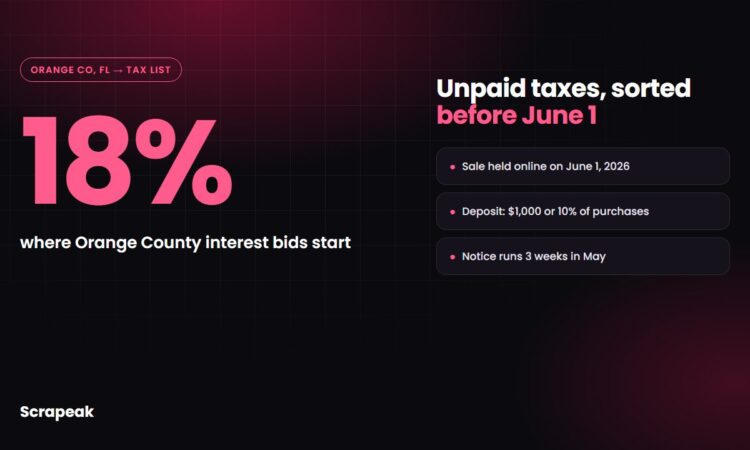
The sale itself is a lien sale. Per the 2026 sale procedures, interest bids start at 18% and go down in quarter-point steps, and the lowest rate wins. A bid of zero earns zero. Bidders post a deposit of $1,000 or 10% of their intended purchases, whichever is greater. The owner can redeem by paying the taxes, interest and advertising cost, and the Tax Collector pays the certificate holder back. If two years pass without redemption, the holder can file a tax deed application, and the deed sale is handled by the Orange County Comptroller, a different office with its own records. You can read the overview on the Tax Collector’s certificate and deed sales page.
If you only need a quick look at one ZIP code, ask us for a free sample of the Orange County file and see what’s in it before you plan anything.
Where the Orange County data lives online, and why it’s hard to collect
The data is spread over four places, each built for a different reader, and none of them makes it easy to export a clean county-wide file.
The Orlando Sentinel notice PDF
The Tax Collector posts the newspaper notice as a PDF. It is laid out in narrow newspaper columns: an item number, a parcel ID like 01-23-28-1231-36101, the owner’s name and the amount due, stacked so tightly that a normal copy and paste mixes up neighbouring rows. We tried plain text extraction on the 2026 file, and an owner from one column landed next to the amount from another. A parser has to read the page by position, rebuild each item, and check that every parcel ID has exactly one amount. The notice also uses a code, HX, for homestead parcels, which you want as its own column.
The Tax Collector’s property tax records search
The notice is a snapshot from May. Owners keep paying after it is printed, so a parcel listed on May 14 may be paid by May 30. The Tax Collector’s records search shows the current status, but one parcel at a time. Checking 10,000 parcels by hand is a few weeks of clicking; a scraper can do it overnight and flag only what changed.
LienHub and the tax roll download
LienHub runs the certificate sale and shows the item list to registered bidders. The Tax Collector’s tax roll download page points to a third-party reports host. Both sit behind bot checks that block simple scripts (our own automated link checker gets turned away), so a scraper there needs a real browser, sensible request rates and a retry plan.
Property Appraiser and Comptroller records
Owner mailing addresses, property use codes and assessed values come from the Orange County Property Appraiser, whose site loads its content with JavaScript, so a plain HTTP request gets back an empty “Loading…” page. Tax deed applications sit with the Comptroller, whose search labels files with statuses such as Active Sale and Active Overbid. Joining all of this on the parcel ID is what turns a list of debts into a list of leads.
Scraping the Orange County list: fields, schedule and delivery
A good Orange County file has one row per parcel and these columns. Some come from the notice, the rest from matching the parcel ID against the other sources.
| Field | What it means |
|---|---|
| parcel_id | Orange County parcel number, the key that joins every source |
| notice_item | Item number in the published notice, which is also the sale order |
| owner_name | Owner as printed in the notice |
| amount_due | Amount advertised for the tax year |
| homestead_flag | Yes when the notice marks the parcel HX |
| property_address | Situs address from the Property Appraiser |
| mailing_address | Where the owner gets mail, which can differ from the property on rentals |
| property_use | Single family, condo, vacant land and so on |
| assessed_value | Value on the current roll |
| tax_year / years_delinquent | Which years are unpaid |
| certificate_number | Filled in once a certificate is sold, where shown |
| status | Unpaid, paid since notice, certificate sold, or tax deed application |
The timing follows the county calendar. From April to June we would run the scraper weekly, then daily in the last week before June 1, re-checking each parcel and marking anything paid since the notice. After the sale, a monthly run catches new tax deed applications. Each run is deduplicated on parcel_id and compared to the previous file, so you get a short “what changed” tab instead of 10,000 rows to read again.
Delivery is whatever fits your workday: a CSV in your inbox on Monday morning, a shared Google Sheet, a JSON feed over an API, or files dropped into S3, Dropbox or Google Drive. If you need phone numbers for the owners, our People Search scraper can add contact details to the rows you choose, and you decide what to do with them within the contact rules above.
The useful view differs by buyer. A certificate buyer filters to amounts under a set size and skips HX parcels. An insurance agent sorts by ZIP and property use. A roofer keeps single-family homes and drops condos, which matters here, because the 2026 notice has long runs of units from the same condo complex.
Build your own Orange County scraper or get a data feed
Building it yourself is realistic if you code. The notice parser is a weekend of work with a PDF library that reads text positions, and the records check is a loop over parcel IDs. The parts that take longer are the bot checks on LienHub and the tax roll host, the JavaScript on the Property Appraiser site, and the fact that the notice layout and the sites can change from one year to the next. If you only care about 200 parcels in two ZIP codes, honestly, doing it by hand with the PDF and the records search is fine.
For the whole county, every year, we would rather run it for you. Scrapeak builds the scraper for these Orange County sources, keeps it working when a page changes, and delivers on your schedule. We run more than 5,000 active scrapers, so a newspaper PDF and a few county sites are routine work. If you want the same thing for other Florida counties, see our posts on the Hillsborough County foreclosure auction list and the Miami-Dade foreclosure auction list, or compare how Texas handles it in our Travis County tax delinquent list post.
Get a free sample of the Orange County tax delinquent list
Tell us the county and list you need and we’ll send you a free sample, usually the same day. After that we can deliver it daily or weekly as a CSV, Google Sheet or API. It works for investors, certificate buyers, contractors, insurance agents and more.
FAQ
Where can I find the Orange County tax delinquent list?
The Orange County Tax Collector publishes the delinquent real estate parcels in the Orlando Sentinel before the June certificate sale and posts the notice as a PDF on octaxcol.com. Registered bidders also see the items on LienHub. For current status, check each parcel in the Tax Collector’s property tax records search.
When is the Orange County tax certificate sale?
The 2026 sale was held online on Monday, June 1, from 8:00 a.m. to 4:00 p.m., in hourly batches of about 2,500 items. Florida sales start on or before June 1 each year, so check the Tax Collector’s site for the 2027 date and procedures.
Can a tax certificate buyer contact the property owner in Orange County?
Be careful. The Tax Collector’s 2026 procedures say a holder who contacts the owner to encourage or demand payment within two years after April 1 of the issue year may be barred from bidding at a certificate sale, under Florida Statute 197.432. Get legal advice before any contact.
Can insurance agents or HVAC companies use an Orange County tax delinquent list?
Yes. Agents use it to find owners who may need a new policy, and HVAC and roofing companies use it to find homes where repairs have likely been put off. Both have to follow do-not-call, TCPA and their own licensing rules when reaching out.
Can the Orange County tax delinquent list be scraped and updated automatically?
Yes. A scraper can parse the newspaper notice PDF into rows, re-check each parcel against the tax records search, add Property Appraiser details, and send you only the changes each week as a CSV, Google Sheet or API feed.