

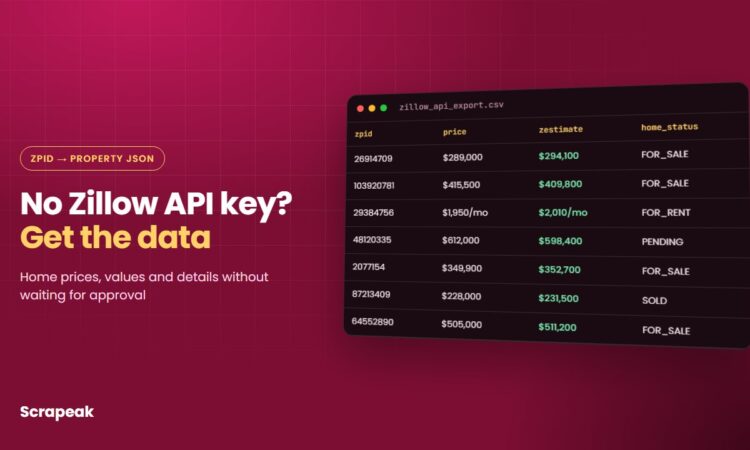
You found an old tutorial, pasted in your Zillow API key, and got an error back. Or you went looking for the Zillow API documentation and landed on a page full of partner programs and request forms. Both mean the same thing: the free Zillow API most guides describe is gone, and what replaced it is mostly for MLSs, brokers and approved businesses.
Below is what Zillow Group offers officially today, who can actually get it, and how people who don’t qualify are getting Zillow data into their spreadsheets and apps anyway.
If you just need the data and don’t care which door it comes through, our Zillow Scraper API returns full property records as JSON, and you can try it free with 1,000 credits.
What happened to the old Zillow API
For years Zillow had a free public API. You signed up, got a key called a ZWSID, and called endpoints like GetDeepSearchResults or GetZestimate to pull a home’s value, beds, baths and square footage. Hobby projects, Google Sheets add-ons and plenty of small SaaS tools ran on it.
That API was retired in 2021. Old keys stopped working, which is why so many forum threads from that year are people asking why their script suddenly returns errors. If a tutorial still shows a ZWSID in the code, it is out of date.
The official Zillow API options in 2027
Zillow Group now keeps its developer offerings on the Zillow Group developers site, which lists close to 20 APIs. Most of the data runs through Bridge Interactive, a Zillow-owned data platform. The ones people usually mean when they search for “Zillow API” are these:
| API | What it gives you | Who gets access |
|---|---|---|
| MLS Listings (Bridge) | MLS listing data through a REST API, in the RESO data format | Invite only; each MLS decides who can see its data |
| Public Records | Parcel, assessment and sale data for US counties, going back about 15 years | Invite only, for commercial use by businesses |
| Zestimates | Property, rental and foreclosure Zestimates for about 100 million US homes | Request form, for commercial use by businesses |
| Reviews API | Agent reviews on Zillow, in bulk | Self serve with a Bridge account |
| Mortgage rates | Average rates quoted through Zillow’s mortgage marketplace | Request form with a partner ID |
The data most people want (listings, prices, Zestimates) sits behind an invitation or a use-case review. The MLS Listings page says access is at the discretion of the individual MLS partners, and the Zestimates API page describes it as a resource for commercial use cases by businesses.
Why most people can’t get a Zillow API key
To request access, you fill in a form with your company, your app and how you plan to use the data. Then Zillow Group, and for listings the MLS itself, decides. A licensed broker building an IDX site has a clear case. An investor who wants every price drop in three ZIP codes, or a startup building a rent analysis tool, usually does not fit any of the boxes.
Even approved access comes with terms about how you can store, show and reuse the data, and those terms differ by dataset. So the official route works well for brokers, MLS vendors and larger real estate companies. For a two-person investing team it is usually a long wait for a “no”.
Zillow also publishes free market-level data (home value and rent indexes by metro, city and ZIP) on its research site. That is handy for trend charts. It won’t tell you anything about a single house, though.
Getting Zillow data with a scraping API instead
When the official door is closed, the practical option is to extract the data from Zillow’s public property and search pages. You can write your own scraper or use a scraping API that does the extraction for you and hands back clean JSON.
Writing it yourself is fine for a few pages. Past that, Zillow blocks automated requests quickly, so you end up managing proxies, retries and page changes. Our guide to scraping Zillow data with Python shows the do-it-yourself version if you want to see what’s involved.
The Scrapeak Zillow Scraper is the other version: a scraping API with its own key, which you get the moment you sign up. These are the calls people use most:
- Property: send a Zillow URL or a ZPID and get the full record, with hundreds of data points such as price, Zestimate, beds, baths, living area and listing status.
- Listing: send a Zillow search URL and get the properties on that page, usually about 40.
- Search ZPID by address: turn a street address into its Zillow property ID.
- Location suggestions, and property data with comparable homes by ZPID.
Each call costs 10 credits, and the free plan’s 1,000 credits cover about 100 calls. That is enough to test the whole flow on one ZIP code before you pay anything.
No Zillow API key? Use ours. Sign up, copy your Scrapeak API key and pull your first Zillow property record in a few minutes. Try it free with 1,000 credits, no credit card required.
Example: pull one property record by ZPID
Here is a single property call in Python. Swap in your own API key and any ZPID (the number before _zpid in a Zillow URL; our Zillow ZPID guide shows where to find it).
import requests

params = {"api_key": "YOUR-API-KEY", "zpid": "26914709"}
response = requests.get(
    "https://app.scrapeak.com/v1/scrapers/zillow/property",
    params=params,
)
data = response.json()
print(data)
You get the property back as JSON, so it drops into a database or a Google Sheets import without extra parsing. With a list of 300 addresses, you would look up each ZPID by address first, then call the property endpoint for each one.
For a whole market, start from a search instead. Send a Zillow search URL for a city or ZIP code to the listing endpoint, collect the ZPIDs, then fetch full records for the homes you care about. The Zillow Scraper docs list every parameter.
Scheduling and delivering Zillow data automatically
Most people don’t want a one-time pull. They want new listings and price changes every Monday morning without thinking about it. You can run the API calls on a schedule yourself, or have us run them hourly, daily or weekly and deliver the export where you work: CSV, JSON or XML files by email, Google Drive, Dropbox, AWS S3 or FTP, or straight through the API.
One habit that saves a lot of cleanup: keep the ZPID as the key in your sheet. Addresses get typed three different ways, and matching on them quietly creates duplicates. The ZPID stays the same, so each weekly scrape updates the right row. Our post on how investors use Zillow data has ideas for what to track once the feed is running.
If you need fields the ready-made scraper doesn’t cover, or Zillow data joined with county records, we can build a custom scraper for it. Simple projects are usually delivered in 2 to 3 days.
Official Zillow API vs a scraping API: which fits you
Go the official route if you are an MLS, a broker or a vendor working for one, or a business with a use case Zillow Group will sign off on. You get licensed data with clear terms, and that matters if you display listings to the public.
Use a scraping API if you need property-level data now, for research, lead lists, pricing or internal analysis, and you don’t qualify for Bridge access. Read Zillow’s terms first and think about what you will do with the data. The rules depend on the site’s terms and your jurisdiction, so talk to a lawyer before you resell or publish anything.
Zillow API FAQ
Is there a free Zillow API?
Not for property data. The old free API that worked with a ZWSID key was retired in 2021. Zillow Group still lists a mortgage rates API and a self-serve Reviews API, but listing, public record and Zestimate data are invite-only or reviewed case by case.
How do I get a Zillow API key?
For most datasets you request access from Zillow Group’s developer site, describe your company and intended use, and wait for approval through the Bridge platform. If you only need property data and are not an MLS, broker or approved partner, a scraping API with its own key is the faster route.
Was the Zillow API discontinued?
The original public API (GetDeepSearchResults, GetZestimate and the ZWSID key) was shut down in 2021, which is why old scripts and spreadsheet add-ons stopped working. Zillow Group now offers data through Bridge Interactive, mostly to MLSs, brokers and approved businesses.
Can I scrape Zillow instead of using the API?
Many teams do, using a scraper or a scraping API that returns Zillow property pages as JSON. Whether it fits your project depends on Zillow’s terms, your use of the data and your jurisdiction, so get legal advice for anything you plan to resell or publish.
Does the Zillow API include Zestimates?
Zillow Group lists a Zestimates API with property, rental and foreclosure Zestimates for about 100 million US homes, aimed at commercial use by businesses and granted on request. A scraped property record also includes the Zestimate wherever Zillow shows it on the page.
Get Zillow data this week without waiting for approval. Start with 1,000 free credits on the Zillow Scraper API, check the pricing plans for larger volumes, or tell us what you need and we’ll quote a custom Zillow data feed.