

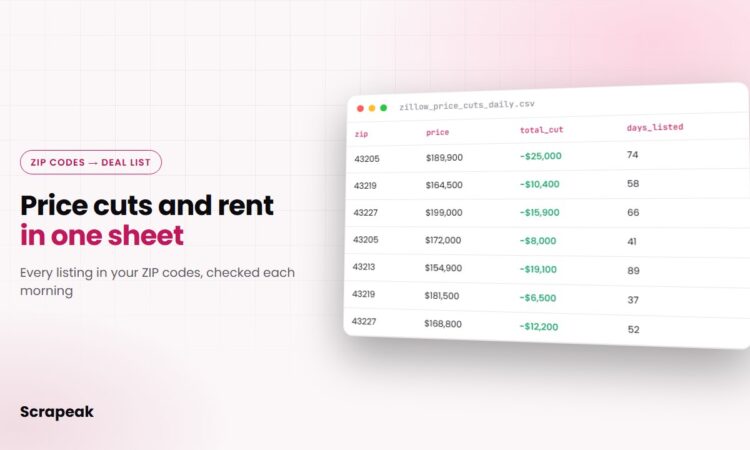
You buy rentals in a handful of ZIP codes, you check Zillow most mornings, and the good ones are still under contract before you finish your numbers. Most of the edge with Zillow data for investors comes from what you track over time: price cuts, stale listings and rent estimates, sitting in one sheet instead of 40 browser tabs.
Here is how one investor runs it, step by step. The investor is made up, but the workflow is one you can copy this week.
The investor in this example
Meet Dana (illustrative). Dana owns six single-family rentals and wants two more this year, all in three ZIP codes on the east side of a mid-size Midwest city. The buy box is simple: 3 beds, under $200,000, and rent that covers the mortgage with room to spare.
Dana’s old routine was a saved search with email alerts. The alerts arrived, Dana opened each listing, copied the price into a spreadsheet, guessed the rent, and moved on. That works for five listings a week. It falls apart at fifty, and it hides the most useful signal of all: how a listing changes from one week to the next.
What Zillow data for investors actually tells you
A single Zillow listing is a snapshot. The value shows up when you collect the same fields every day and compare. These are the ones Dana cares about:
- price and priceHistory: every list price, cut and relist, with dates.
- daysOnZillow: how long the current listing has been up.
- zestimate: Zillow’s automated value, useful as a rough sanity check.
- rentZestimate: Zillow’s estimated monthly rent for the home.
- bedrooms, bathrooms, livingArea, yearBuilt and the zpid (Zillow’s ID for the property).
One catch: daysOnZillow can reset when an agent pulls a listing and puts it back up. The price history usually shows the first list date, so that is the number to trust when you want to know how long a seller has really been waiting.
Step 1: Scrape the same ZIP codes every morning
Dana’s first change was to stop browsing and start scraping. A scraper opens the Zillow search results for each ZIP code, reads every listing card and writes a row per home into a spreadsheet: address, zpid, price, beds, baths, square feet and days listed.
With the Scrapeak Zillow Scraper, one search results page returns about 40 properties for 10 credits. Three ZIP codes with roughly 120 active listings means three or four pages a day. The scrape is scheduled for 6 a.m., so the fresh file is waiting before coffee.
Run it on a schedule. A one-off export shows what is for sale today, while a month of daily exports shows which sellers are getting nervous.
Want to see your own ZIP codes as a spreadsheet? The free trial gives you 1,000 credits, no credit card needed. That is enough for about 100 search pages, or roughly 4,000 listing rows. Try it free with 1,000 credits.
Step 2: Pull full property records for the shortlist
Search results give you the basics. The full property page has the fields that matter for a decision: the whole price history, the rentZestimate, tax history, HOA fees and the listing agent.
Dana doesn’t scrape full records for all 120 homes. The daily file filters itself down first: 3 beds, under $200,000, not already pending. That usually leaves 15 to 25 homes. The scraper then pulls the full record for each one by zpid, at 10 credits per property.
Scraping only the shortlist keeps the cost low. In this example, 20 full records a day is 200 credits, which is a small bill for a pipeline that does an hour of clicking for you.
Step 3: Turn the scraped data into a deal score
Once the data sits in a spreadsheet, a few formulas do the sorting. Dana’s sheet adds four columns to every scraped row:
- Total cut: first list price minus current price, from priceHistory.
- Real days listed: today minus the first list date, not the reset counter.
- Gross yield: rentZestimate times 12, divided by price. A home listed at $185,000 with a rent estimate of $1,650 comes out at about 10.7%.
- Price vs zestimate: how far the asking price sits above or below Zillow’s estimate.
The rows at the top of the sort are the calls Dana makes that day: homes listed for 60+ real days, with two or more cuts and a gross yield that clears the target. A listing that dropped from $214,900 to $189,900 over seven weeks tells you more about the seller than the listing description does.
Don’t trust the rentZestimate on its own. Zillow describes it as a starting point, and it can be far off in small or mixed neighborhoods. Dana checks the shortlist against HUD’s Fair Market Rents and against current rental listings in the same ZIP, which the same scraper can collect.
Why the scraped data beats saved searches and alerts
Alerts tell you something changed. A scraped dataset tells you what changed, by how much, and how often. That history is what lets you spot a pattern, like a builder cutting prices across a whole street, or a ZIP where days on market jumped from three weeks to eight over one quarter.
It also gives you a record to negotiate with. When you can say “this home has been listed for 74 days and cut twice,” your offer rests on numbers the agent can check for themselves.
It is also easy to grow. Adding a fourth ZIP code to a scheduled scraper is one more line in a settings file. Adding it to a manual routine is another half hour every morning.
What breaks when you scrape Zillow yourself
Plenty of investors try a DIY script first. We wrote a whole guide on how to scrape Zillow data with Python, and it works for a weekend project. Running it every day is where people get stuck:
- Zillow uses bot protection, so plain requests start getting blocked or served CAPTCHA pages after a few dozen hits. You end up paying for rotating proxies.
- Search pages cap how many results they show, so a busy ZIP needs to be split by price band to get every listing. That pagination logic is easy to get wrong without noticing.
- Zillow changes its page structure from time to time. When it does, a home-made scraper quietly returns empty fields, and you find out a week later.
- Somebody has to keep the scheduled job running, store the history and remove duplicate rows when a home shows up in two searches.
With Scrapeak, the API handles the blocking and parsing, and we fix the scraper when Zillow changes. You get clean JSON or CSV, and you can have it delivered to Google Sheets, email, Dropbox, an S3 bucket or straight to your own app through the API. Runs can be hourly, daily or weekly.
When you don’t need a scraper at all
If you look at fewer than 20 listings a week in one ZIP code, a saved search and a spreadsheet are fine. Scraping earns its keep once you track several areas, want price history over months, or have more than one person working the list.
If your buy box needs data Zillow doesn’t show, such as county tax records or code violations, the answer is usually a second source joined to the Zillow data by address. We build that kind of custom scraper regularly, and simple projects are delivered in 2 to 3 days. You can check what plans cost on the pricing page.
Frequently asked questions
Can investors use Zillow data to find deals?
Yes. The most useful signals are price cuts, the real number of days a home has been listed, and how the asking price compares with the rent estimate. Tracked daily across a few ZIP codes, they show you motivated sellers before most buyers notice.
Is it legal to scrape Zillow?
Listing pages are public, but whether scraping them is allowed depends on Zillow’s terms of use and on where you are. We only collect publicly visible data. For your own situation, it is best to get advice from a lawyer.
How accurate is the Zillow rent estimate?
Zillow calls the rentZestimate a starting point. It is useful for sorting a list, but check the final candidates against real rental listings in the same ZIP code and against HUD Fair Market Rents before you make an offer.
Does days on Zillow reset when a home is relisted?
It can. When a listing is taken down and put back up, the counter may start again. The price history keeps the earlier dates, so use the first list date to measure how long the home has really been for sale.
How much does it cost to scrape Zillow listings?
With the Scrapeak Zillow Scraper, a search page of about 40 listings costs 10 credits, and a full property record costs 10 credits. The free trial includes 1,000 credits, which is enough to test a few ZIP codes.
Get your ZIP codes into a daily Zillow sheet. Start with 1,000 free credits and run the Zillow Scraper on the areas you buy in. Need county records or another site joined to it? Tell us what you need and we will quote it.