

Most Palm Beach County probate cases start the same way: an attorney e-files a petition with the Clerk of the Circuit Court in West Palm Beach, and the original will gets dropped off at the main courthouse on Dixie Highway or at the branches in Delray Beach and Palm Beach Gardens. Palm Beach County probate leads are those filings matched to the house the person left behind.
Four kinds of businesses ask us for them most: insurance agencies, estate sale companies, HVAC and other home-service contractors, and real estate investors. Each wants the same short list (the estate, the personal representative, the property, the attorney) and each wants it before the family has already made its calls.
Plenty of homes in Palm Beach County belong to seasonal residents, and when a nonresident dies owning Florida real estate, the heirs usually open an ancillary administration in the county where the property sits. The personal representative may live in Ohio or New York while the condo in Boca Raton sits closed up for months, so the mailing address on the case matters as much as the property address.
Who uses the Palm Beach County probate list
Insurance agencies
An inherited home often sits empty while the estate is open, and many homeowners policies limit coverage once a house has been vacant for a while. The personal representative may need a vacant-dwelling policy now, and whoever ends up with the house (an heir who moves in, a landlord, a buyer) needs a new policy later. In South Florida that conversation usually includes wind coverage and a wind mitigation inspection, which gives a local agent something specific to offer on the first call.
Estate sale companies, appraisers and home inspectors
Florida gives the personal representative 60 days after letters are issued to file an inventory of the estate. Someone has to value the furniture, the art and the car in the garage, and somebody has to sell the contents before the house can be listed. Estate sale firms and appraisers who see the case the week letters go out are early enough to help with that inventory.
HVAC, roofing, pool and other home-service companies
A house that has been shut for a summer in Palm Beach County usually needs its air conditioning checked first. Heirs getting ready to sell also tend to book roof inspections, pool service, pest control and repairs that the buyer’s inspector would flag. A contractor with the property address and the representative’s contact details can offer a pre-sale checkup instead of waiting for a listing photo to show the problem.
Real estate investors and wholesalers
Investors use probate filings to reach heirs who may not want a house, especially heirs in another state. Florida gives creditors three months after the first notice to creditors is published to file claims, so most estates take at least that long to wind up. That window is a reasonable time to make a respectful offer.
These families are grieving. Keep the first contact short and polite, check the federal and Florida do-not-call lists before you phone anyone, and follow your own licensing rules if you sell insurance or real estate. This is general information, not legal advice.
How probate works in Palm Beach County
Probate in Palm Beach County runs through the probate division of the 15th Judicial Circuit, and the Clerk of the Circuit Court and Comptroller (mypalmbeachclerk.com) keeps the files. Its probate FAQ explains filing and searching, and the Probate Department answers questions at (561) 355-2986. The steps below come from Florida’s probate code and apply here.
| Step | Florida rule |
|---|---|
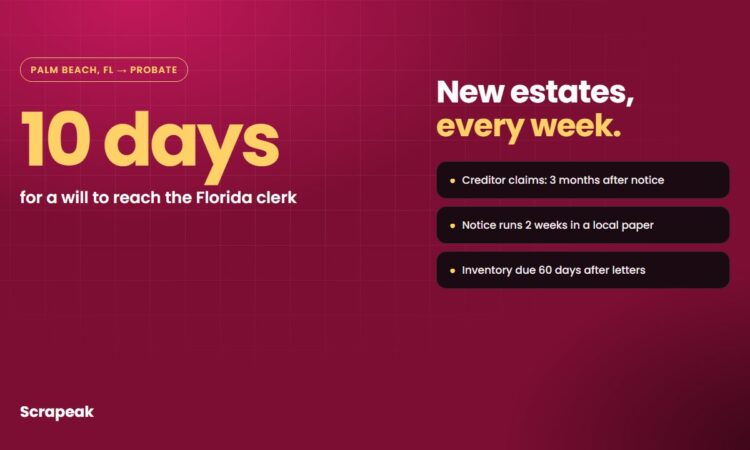
| Will deposited | Whoever holds the original will deposits it with the clerk within 10 days of learning of the death (s. 732.901) |
| Case opened | Formal administration, or summary administration when the non-exempt estate is $75,000 or less or the death was more than two years ago (s. 735.201) |
| Notice to creditors | Published once a week for two weeks in a newspaper in the county (s. 733.2121) |
| Creditor claims | Due three months after first publication, with a two-year outer limit after death (s. 733.702, s. 733.710) |
| Inventory | Filed within 60 days after letters are issued (s. 733.604) |
Two details matter for lead lists. Not every death becomes a case, because homes held in a trust or jointly can pass without one. And a summary administration can be over quickly, so those files are worth checking the week they appear.
Want to see recent Palm Beach estates matched to property records? Ask us for a free sample.
Where Palm Beach probate data lives online, and why it’s slow to collect
No one publishes a ready list of new estates with property attached. The pieces sit on three or four public sites, and none of them has an export button, so the list has to be scraped and stitched together.
The Clerk’s eCaseView
The Clerk’s eCaseView portal is where the dockets live, searchable by party name or case number. Two things slow down anyone trying to extract data from it. The Clerk’s security update says guest users can’t see probate cases, so you need a registered account, and the search answers one question at a time (“what’s in this case?”) instead of “which cases were filed this week?”. Older files are thin too: the Clerk notes that most court records before 2008 were never imaged. A scraper has to work inside a registered session, page through case numbers or filing dates, and parse each docket for the events that matter (letters issued, notice published, inventory filed).
Notices to creditors
The notice to creditors is the easiest lead source to parse, because Florida law requires it to name the personal representative and the attorney with their addresses, along with the case number and the date of first publication. Notices run in local newspapers, and Florida newspapers also post their legal notices on floridapublicnotices.com. The catch is that each notice runs twice, a week apart, so a scraper that doesn’t deduplicate by case number will hand you every estate two times.
The Property Appraiser
Turning an estate into a property lead means matching the decedent’s name against Palm Beach County Property Appraiser records (pbcpao.gov). This is where hand-copying falls apart. Names show up as “Smith John A” on one site and “John A. Smith” on another, common names match a dozen parcels, and some homes are already titled to a trust or a surviving spouse. A matching step that compares middle initials, the decedent’s last known address from the case file, and the owner mailing address catches most of these.
Official records
Deeds signed by a personal representative and other estate documents get recorded in the Clerk’s official records. Watching those tells you when a probate property has already been sold, so you can drop it before anyone calls.
Copy all of this by hand and you get the usual mess: the same estate twice, cases with no real estate at all, a representative’s address you never looked up, and a house that sold last month still on the list. For five estates a month in one ZIP code, a notepad works. For the whole county, from Jupiter down to Boca Raton, it’s a weekly chore that never stays current.
Scraping Palm Beach County probate leads: fields, schedule and delivery
A good probate feed is one row per estate, with the property matched and the contact details checked. These are the fields we extract and how each one is used.
| Field | What it means |
|---|---|
| case_number | Florida uniform case number, in Palm Beach starting with 50 and carrying CP for probate |
| filing_date | When the petition was filed |
| case_type | Formal, summary or ancillary administration |
| decedent_name | Name of the person who died, as shown on the case |
| personal_representative | Who the court appointed to handle the estate |
| representative_address | Mailing address from the notice to creditors, often out of state |
| attorney | Estate attorney named in the notice |
| notice_first_published | Starts the three-month creditor window |
| property_address / parcel_id | Home matched from Property Appraiser records |
| estimated_value | Market value from the appraiser, where available |
On schedule, we check new notices every day, re-scrape open cases weekly to pick up new docket events, and remove properties once a personal representative’s deed is recorded. Each run compares against the last one, so your sheet shows only new or changed estates instead of the whole county again.
For delivery, you get a CSV or Google Sheet, an API endpoint, or a file dropped into S3, Dropbox or Google Drive on the schedule you pick. If you need phone numbers for the personal representatives, our People Search scraper runs skip tracing on the same rows (100 credits per search). Many buyers filter the feed before it reaches them, for example estates with a single-family home in 33418 or 33496, or only ancillary cases with an out-of-state representative.
Build your own scraper or get a probate feed
You can build this yourself. A developer who knows Python could get the newspaper notices parsing in a few days. The hard part is everything after: keeping a registered eCaseView session working, matching names to parcels without false hits, deduplicating the two-week notice runs, and fixing the scraper each time one of these sites changes its layout. If you only need a handful of estates a month, honestly, read the notices yourself every Friday.
If you want the whole county every week, we build and run the scraper for you. Simple projects go live in two to three days, we keep the scraper working when the sites change, and you only get the rows you asked for. We’ve written up how this works for Broward County pre-foreclosure filings and the Miami-Dade foreclosure auction list, and a Palm Beach probate feed uses the same setup.
Get a free sample of the Palm Beach County probate list
Tell us the county and list you need and we’ll send you a free sample, usually the same day. After that we can deliver it daily or weekly as a CSV, Google Sheet or API. Insurance agents, estate sale firms, contractors and investors all use the same feed with different filters.
FAQ
Are Palm Beach County probate records public?
Most of a Florida probate file is a public court record, including the case number, the decedent’s name and the personal representative. Some filings, such as death certificates and certain financial details, are kept confidential. To view probate dockets on the Clerk’s eCaseView you need a registered account, because guest users can’t open probate cases.
How soon after a death does a Palm Beach probate case appear?
There is no single deadline to open a case. Whoever holds the original will must deposit it with the Clerk within 10 days of learning of the death, but the case only opens when someone petitions the court. The notice to creditors, which is the easiest record to collect, appears after the personal representative is appointed.
Can HVAC companies or insurance agents use the Palm Beach probate list?
Yes. Inherited homes often sit empty and need a vacant-dwelling or new homeowners policy, plus air conditioning, roof or pool work before a sale. Keep the first contact respectful, check do-not-call lists, and follow your licensing rules for marketing.
What is ancillary administration, and why does it matter in Palm Beach?
It is a Florida probate case opened for someone who lived in another state but owned property here. Many Palm Beach County homes belong to seasonal residents, so these cases often list a personal representative with an out-of-state address, which is the address you need for mail.
Can you scrape Palm Beach County probate leads automatically?
Yes. A scraper can collect notices to creditors every day, check the Clerk’s dockets for new events, match each estate to Property Appraiser records and remove duplicates. Scrapeak builds and runs that feed and sends a free sample first, usually the same day.