

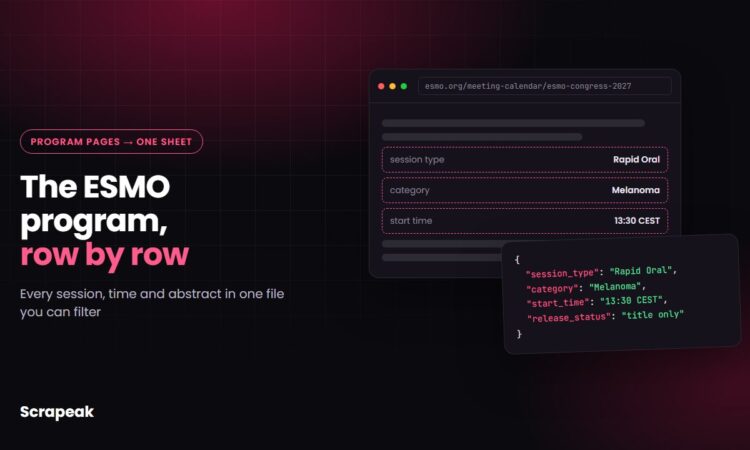
ESMO Congress 2027 runs from 17 to 21 September at Fira Barcelona Gran Via, and if your team plans booth staff, customer meetings or a literature review around it, someone will be asked for “the program in a spreadsheet.” The ESMO Congress abstracts and the full session program are public. The catch is that they sit in different places, arrive in stages over the summer, and were built for an oncologist browsing one topic, not for a team that wants every session in one file.
Below: what ESMO publishes and when, where each piece lives, and how a scraper turns it into a dataset you can filter by day, track and session type.
What ESMO publishes, and when it goes online
The 2027 abstract submission hadn’t opened when we checked the official ESMO Congress 2027 page, so the best guide is last year’s timetable. ESMO posted it on the ESMO Congress 2026 abstracts page:
- 12 May 2026, 21:00 CEST: deadline for regular abstracts, Trials in Progress and the “intent to submit” placeholder for late-breaking abstracts.
- 8 to 10 July: authors hear whether they were accepted.
- By 17 July: titles of accepted regular abstracts expected online in the Programme section.
- 8 September, 21:00 CEST: late-breaking abstract (LBA) deadline.
- By 25 September: accepted LBA titles expected online.
- 30 September: presenter registration deadline. If nobody registers to present an abstract, it is removed from the online program and from the Abstract Book.
- 23 to 27 October: the congress itself, in Madrid.
Barcelona 2027 is about five weeks earlier in the year than Madrid was, so expect each of those dates to move forward.
All accepted abstracts end up in the ESMO Congress Abstract Book, a supplement to Annals of Oncology. They are presented in five formats: Presidential Symposium talks, Proffered Papers, Rapid Orals, paper Posters and ePosters. An ePoster is a PDF shown on the virtual platform and on screens at the venue, and its presenter doesn’t have to attend.
For roughly two months, then, your file can only hold titles and session slots. LBA titles arrive a few weeks before the meeting, and some rows will still drop out after the registration deadline.
Planning for ESMO 2027? Tell us which cancer types and fields you care about, and we’ll send a free sample and a quote. Request a free sample
Who asks for an ESMO program file
Mostly people who aren’t oncologists. An events lead at a diagnostics company wants to know which days and halls are heavy on lung or breast sessions, so the booth is staffed when those rooms empty out. A medical communications team builds its content calendar around the sessions in its therapy area. Research and data teams want the abstract text itself for a literature review, or a count of abstracts per category compared with last year.
None of them wants to click through hundreds of session pages. They want rows and columns.
Where the ESMO program and abstracts live online
There are three sources, and a useful dataset usually combines two of them.
The online programme is the backbone. ESMO’s programme page links to a conference calendar hosted on a separate meeting platform. For 2026 it was a grid by day and room, with a legend of session types such as Proffered Paper, Rapid Oral, Poster, Educational and industry satellite symposia. Each session page lists the date, time, room and chairs, then every presentation in that session: abstract number, title, speaker, lecture time, authors with city and country, and a link to the abstract.
The Abstract Book holds the full abstract text. It is better for text and citations and weaker on schedule details, so a scraper joins it to the programme rows on the abstract number.
The ESMO events app lets attendees browse the program by day, topic, cancer type and track, which is handy on the floor but gives you nothing to export. After the congress, ESMO moves on-demand resources to OncologyPRO, and some of that material may need an ESMO account. For a dataset, we extract from the public programme pages and the Abstract Book and leave anything behind a login alone.
How to scrape the ESMO program into one spreadsheet
A scraper does the clicking for you, on a schedule, and writes everything into the same columns every time. For ESMO the build usually looks like this:
- Map the sessions. The conference calendar is rendered with JavaScript, so “view source” shows very little. The scraper either reads the background requests the calendar makes, which is faster and breaks less, or renders the page in a headless browser. Then it collects every session link for every congress day.
- Visit each session page. Session fields are captured once, then the scraper writes one row per presentation inside the session. Invited discussant slots and Q&A blocks show up as items too, so they get tagged and can be filtered out.
- Join the abstract text. Once the Abstract Book is out, each row is matched to its abstract on the abstract number. Until then the text column stays empty and the row is marked “title only.”
- Clean dates and times. The platform shows dates like 23.10.2026, which we convert to ISO dates. Times get an explicit time zone: the 2026 program switched from CEST to CET partway through the congress, and ESMO put a note on the calendar about it.
- Schedule re-runs. Weekly once titles appear in July, daily after LBA titles land in September, and every morning during the congress. Each run flags rows that are new, changed or removed since the last one.
- Deliver. CSV or Excel to email or Google Drive for the events team, JSON to S3 or an API for the data team.
When Scrapeak builds this, the first sample comes from whatever part of the program is already public, so you can check the columns months before the full ESMO 2027 program fills in. Simple projects are delivered in 2 to 3 days, formats include CSV, JSON, JSONLines and XML, and we’ll sign an NDA if you’d rather keep your congress plans private. If you want to see how we approached another oncology meeting, read our guide to turning ASCO Annual Meeting abstracts into a dataset.
Fields to extract from ESMO Congress abstracts and sessions
Start with the fields your team will actually filter on. Every extra column adds build and cleaning time, and you can add more later.
| Field | Sample value | What it’s for |
|---|---|---|
| abstract_number | 1234P, LBA00 | The join key between program and Abstract Book |
| presentation_title | Sample study title | Keyword search |
| session_title, session_type | Rapid Oral, Proffered Paper | Separating talks from posters |
| category | Melanoma, SCLC | Filtering by cancer type |
| date, start_time, end_time, timezone | 2027-09-18, 13:30, CEST | Booth staffing and meeting slots |
| room | Sample Auditorium, Hall 0 | Walking routes on a big venue |
| presentation_format | Poster, ePoster | Knowing whether a presenter will be onsite |
| presenter_city, presenter_country | Sample City, Spain | Counts by country or region |
| abstract_text, abstract_url | Background, methods, results | Literature review and going back to the source |
| release_status, last_seen | title only, released, removed | Seeing what changed since yesterday |
The last row saves the most time. A release_status column tells everyone whether a row is a July title or a full abstract, and a “removed” flag explains why a session that was in last week’s file is gone. If you also need journal-style metadata for abstracts that carry a DOI, our DOI scraper guide covers that step, and the broader medical conference data guide compares how different congresses publish.
Tired of copying sessions into Excel by hand? We can deliver the ESMO program as a CSV or Google Sheet and keep it updated through the congress. Get a quote
What trips up an ESMO scraper
None of this is unusual, but each one costs a day if you find it the hard way.
The program moves every year. The 2026 calendar had “esmo2026” in its web address, and the 2027 one will live somewhere new. Expect the scraper to need a small update when the new program goes live, and plan the first run for the week the titles appear.
Rows disappear without notice. Abstracts can be pulled after the presenter registration deadline, and sessions can change room or time. Comparing each run with the previous one is the only reliable way to catch a missing or moved row.
Not every item is a presentation. Discussant talks, Q&A slots and industry satellite symposia sit next to abstracts in the same session lists. A session_type and item_type column lets your team keep or drop them with one filter.
Some content is behind a login. We only collect publicly available pages and don’t work around logins or paywalls. Site terms apply, so check them for your use case and get legal advice if you’re unsure; we can’t promise any particular use is allowed.
ESMO is a European congress, held in Spain, and a large share of presenters work in the EU. Names, cities and affiliations of people in the EU are personal data under GDPR, so you need a lawful basis to store them, should keep only the fields you use, and should set a deletion date for the file. Patient data is never part of this; congress programs only describe research.
FAQ
When are ESMO Congress abstracts released?
For ESMO 2026, titles of accepted regular abstracts were expected online by 17 July and late-breaking titles by 25 September, with all accepted abstracts published in the Abstract Book. ESMO hadn’t published the 2027 timetable yet when we checked, and the congress is earlier in the year, so expect earlier dates.
Where are ESMO abstracts published?
All accepted abstracts are published online in the ESMO Congress Abstract Book, a supplement to Annals of Oncology. Session times, rooms and presentation lists are in the online programme, and on-demand material moves to OncologyPRO after the congress.
When and where is ESMO Congress 2027?
ESMO Congress 2027 takes place from 17 to 21 September 2027 at Fira Barcelona Gran Via in Barcelona, Spain, with sessions also on a virtual platform.
Can I export the ESMO program to Excel?
The online programme and the ESMO events app are built for browsing, not exporting. To get every session and abstract in one Excel or CSV file, the program pages have to be scraped and cleaned. Scrapeak can build that and send you a free sample first.
Is it legal to scrape ESMO abstracts?
It depends on the site’s terms, your jurisdiction and how you use the data. Stick to public pages, follow GDPR for personal data about people in the EU, and get legal advice for commercial use.
Want the ESMO 2027 program as one spreadsheet? Send us the cancer types, fields and update schedule you need. We’ll reply with a free sample and a quote. Request your free sample
Prefer to test scraping on your own first? Try it free with 1,000 credits, no credit card needed.