

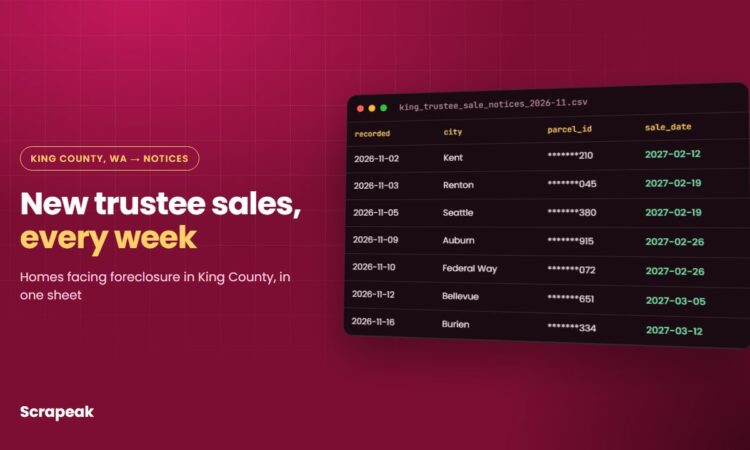
If you want a King County pre foreclosure list, you’ll find out fast that the county doesn’t publish one. The early signal is a single recorded document, the notice of trustee’s sale, sitting in the Recorder’s Office index between deeds, liens and easements. Anyone who wants to reach a Seattle, Bellevue or Kent homeowner before the sale has to pull those notices out one search at a time.
The people who ask us for this list are mostly HVAC and roofing companies, insurance agents and investors, plus a few housing counselors who want to reach owners in time for mediation. Below is how Washington’s process works in King County, where the notices live online, and how we scrape them into a weekly file you can actually use.
Who uses the King County pre-foreclosure list
HVAC, roofing and home-service companies
A house headed to a trustee’s sale often has a furnace or roof the owner couldn’t afford to fix. The next owner usually fixes it, and Puget Sound rain finds every weak spot in an older roof. A contractor who knows the address 90 days before the sale can be the first name the buyer hears.
Insurance agencies
Homes in foreclosure often end up vacant, and a standard homeowner policy may not cover a vacant house the way it covers an occupied one. Whoever buys at the sale, or from the bank later, needs a new policy right away. A dated list of notices gives an agent a calendar instead of guesswork.
Investors and wholesalers
Washington foreclosures on a deed of trust don’t go through a judge, so the clock is short and fixed. That’s the useful part for an investor: once the notice is recorded you know the sale date, and you have a few months to talk to the owner about a sale, a short sale or a lease-back before bidders show up.
Housing counselors and foreclosure-prevention groups
Washington’s foreclosure mediation program depends on a housing counselor or attorney referring the homeowner, and under RCW 61.24.163 that referral has to happen no later than 90 days before the sale date in the notice. A counselor who sees new notices the week they’re recorded can still reach people inside that window.
For every group, calls and texts have to follow do-not-call lists and TCPA rules, and agents and lenders have their own marketing rules. That’s general information, not legal advice.
How pre-foreclosure works in King County
Most Washington mortgages are deeds of trust, so a trustee runs the foreclosure under chapter 61.24 RCW instead of a court. The order is fixed by statute:
| Step | What happens | Public? |
|---|---|---|
| Pre-default contact | The lender writes to and tries to call the borrower before a notice of default (RCW 61.24.031) | No |
| Notice of default | Sent to the borrower at least 30 days before the notice of sale is recorded | No |
| Notice of trustee’s sale | Recorded with the county at least 90 days before the sale, or 120 days when the pre-default letter applies | Yes, in the recorder’s index |
| Newspaper notice | Published twice in a legal newspaper, 35 to 28 days and 14 to 7 days before the sale | Yes |
| Trustee’s sale | Public auction on a Friday (Monday if Friday is a holiday), postponable up to 120 days in total | Yes |
The timing rules are in RCW 61.24.040. Recent notices in the Seattle Times legal section list sales at the King County Administration Building in downtown Seattle, but the place is set in each notice, so read it rather than assume.
One thing confuses people: the King County Treasury also forecloses, for unpaid property taxes. It posts a list of tax foreclosure parcels each November. That’s a different list from mortgage pre-foreclosures. If you want either one as a file, ask us for a free sample.
Where the King County pre foreclosure list data lives online, and why it’s slow to collect
The main source is the Recorder’s Office online records search, which runs on a LandmarkWeb portal. It’s free and covers most documents recorded since August 1, 1991. You can search by name, document type, recording date, recording number or parcel ID. So the official route is: pick the trustee’s sale document type, set a date range, and page through the results.
That works for ten records. At a few hundred it turns into a part-time job, which is why we scrape the portal instead of clicking through it. The problems are the same ones we see on most county record portals:
- Results load one page at a time, and the county’s own help page says you have to re-apply sorting and filtering on each page.
- The index row gives you grantor, grantee and recording number. The sale date, trustee sale number and amount owed sit inside the document image, which you open record by record.
- The “grantor” on a trustee’s sale notice is often the trustee company, so the homeowner’s name and the property address have to be read from the notice itself.
- Amended notices, discontinuances and rescheduled sales are recorded as separate documents. If you don’t link them back to the original, your list keeps homes that are no longer in foreclosure.
- Indexing standards change over time, so a document type filter that worked for 2019 can miss records today.
The county does have a free alert service (RANS) that emails you when a document is recorded under a name you register. That’s useful for watching your own property, not for finding every new notice across the county.
The second source is the newspaper. Trustees publish each notice twice in a legal newspaper, and many King County notices run in the Seattle Times legal classifieds. Those pages are long blocks of legal text, so a scraper has to parse out the parcel number, sale date and trustee number from free-form paragraphs. By the time the second publication runs, the sale is one to two weeks away, so the newspaper is better for checking than for finding leads early.
Doing this by hand usually breaks in the same place. Someone copies 40 notices into a spreadsheet on Monday instead of automating it, misses the amendments, and three weeks later half the follow-up calls go to owners who already cured the default.
Scraping the King County list: fields, schedule and delivery
A scraper does the clicking for you: it queries the recorder’s index for new trustee’s sale notices, opens each document, and pulls the fields into one row per property. These are the fields we usually extract:
| Field | What it means |
|---|---|
| recording_date | Date the notice was recorded with King County |
| recording_number | The county’s unique number for the document |
| document_type | Notice of trustee’s sale, amended notice, or discontinuance |
| sale_date | Scheduled trustee’s sale date from the notice |
| trustee_sale_number | The trustee’s file number (TS number), used to link amendments |
| parcel_id | King County parcel number (APN) |
| property_address | Street address and city from the notice |
| owner_name | Grantor on the deed of trust |
| trustee / beneficiary | Trustee company and the lender or servicer |
| amount_in_arrears | Default amount stated in the notice, where given |
| mailing_address | Owner’s mailing address if different, from enrichment |
Freshness comes from the schedule. We usually run a King County scraper every weekday or once a week, pull only documents recorded since the last run, and match each new record against what’s already in your file by trustee sale number and parcel. An amended notice updates the sale date on the existing row. A discontinuance marks the row as closed so you stop calling that owner.
Many teams also want phone numbers. Our People Search scraper can add contact details for the owner name and address, and parcel data can add assessed value and year built, which roofers and HVAC companies use to sort out the older houses first.
Delivery is whatever your team already uses: a CSV in your inbox, a Google Sheet that fills itself, JSON through an API, or a push into your CRM. If you’re new to this kind of list, our guide to preforeclosure leads covers how teams work them, and the Broward County pre-foreclosure list post shows how the same job looks in a Florida court-based county.
Build your own King County scraper or get a feed
You can build this yourself. LandmarkWeb portals are scrapable with a headless browser, and a developer can get a first version working in a few days. The hard part is everything after the first version. You’ll need to read data from document images (often with OCR), match amendments to originals, handle the portal’s maintenance windows and layout changes, and keep it all running every week without someone babysitting it.
If you need one or two counties and have a developer with spare time, building in-house is reasonable. If you need King County plus Pierce and Snohomish, or you don’t want to own the maintenance, a managed feed is usually cheaper once you count the hours.
That’s what we do at Scrapeak. We build the King County scraper, run it on your schedule, fix it when the portal changes, and send you clean rows. Simple projects are usually live in two to three days, and you can see how pricing works on our pricing page.
Get a free sample of the King County pre-foreclosure list
Tell us the county and list you need and we’ll send you a free sample, usually the same day. After that we can deliver it daily or weekly as a CSV, Google Sheet or API. Works for investors, contractors, insurance agents and counselors.
FAQ
Does King County publish a pre-foreclosure list?
No. The county runs a free official records search where trustee’s sale notices are recorded, and the Treasury posts a separate list of tax foreclosure parcels each November. Nobody at the county compiles mortgage pre-foreclosures into one list, so you either search the records yourself or have them scraped into a file.
What document starts a foreclosure in King County?
Most Washington home loans use a deed of trust, so foreclosure usually runs outside court. The borrower gets a notice of default first, and the first recorded, public document is the notice of trustee’s sale. Under RCW 61.24.040 it has to be recorded at least 90 days before the sale (120 days when the pre-default letter applies).
Can roofers, HVAC companies or insurance agents use the King County pre foreclosure list?
Yes. The list is a set of addresses where ownership may change in the next few months, which is when new owners book inspections, repairs and new policies. Outreach still has to follow do-not-call, TCPA and your own licensing rules.
How fresh can a scraped King County pre-foreclosure feed be?
As fresh as the recording index. A scraper can check the recorder’s search every weekday, pull notices recorded since the last run, drop duplicates and amended re-filings, and send you only the new rows as a CSV, Google Sheet or API call.
Is the Treasury’s tax foreclosure list the same thing?
No. That list covers parcels with property taxes three or more years unpaid, which the county itself forecloses. Trustee’s sale notices come from lenders’ trustees. Many investors want both, and we can scrape them into one file with a column that says which is which.