

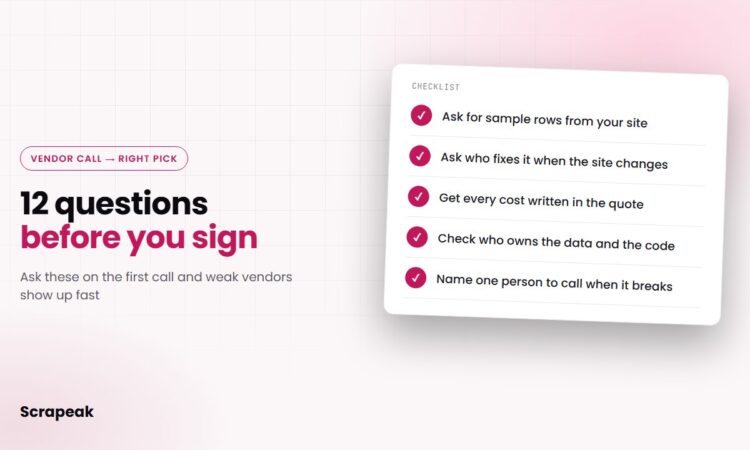
You have a website full of data you need, a deadline, and three scraping vendors who all say they can do it. On the sales call they sound the same. Six weeks later they won’t: one is still sending clean files every Monday, and another went quiet after the target site changed its layout.
This is how to choose a web scraping company without learning that the hard way. Below are 12 questions we’d ask if we were on your side of the table, what a good answer sounds like, and the replies that should make you end the call. We build and run scrapers for a living at Scrapeak, so yes, we’re a vendor too. Hold us to the same list.
If your project is small and the site is one we already cover, you may not need a vendor call at all. Our ready-made scrapers can be tested with 1,000 free credits, no credit card needed.
How to choose a web scraping company: write a short brief first
Vendors can only answer well if you ask about a specific job. Before any call, write down five things:
- The exact pages you want scraped: a search results page, a product category, or a list of 2,000 URLs.
- The fields you need, by name. Price, SKU, stock status, rating and address are fields. “All the data” is not.
- Rough volume. 300 rows a week and 3 million rows a day are very different projects.
- How often the data must refresh: once, daily or hourly.
- Where it should land, for example a CSV in your inbox, a Google Sheet, an API or an S3 bucket.
Send the same brief to every company you talk to. The quotes then compare like for like, and you’ll quickly see who read it and who sent a template reply. Our custom scraper request form asks for exactly these points, so you can use it as a checklist even if you never press submit.
Questions about the data you’ll receive
1. Can I see sample data from my target site?
This is the fastest filter there is. A company that can scrape the site you care about can usually show a small sample (20 to 50 rows with the real fields) before you pay for a full build. Some charge a little for samples on hard sites, which is fair.
Be careful with a vendor that only shows a polished demo from some other website. Scraping Amazon well tells you nothing about whether they can extract records from a county portal full of scanned PDFs.
2. Which fields will I get, and what happens when one is missing?
Ask for the field list in writing, with each field name and a sample value. Then ask the less comfortable question: what does the export look like when a listing has no phone number, or the price says “call for price”?
A vendor who has done this before answers right away. The field comes back empty, never with a guessed value, and the columns stay in the same order on every run. If the dataset goes into a CRM or a dashboard, that consistency matters more than any single field.
3. How do you check data quality before it reaches me?
Scraped data goes wrong quietly. A site moves its price into a new tag, the scraper keeps running, and the price column fills with blanks. You find out two weeks later from a confused sales rep.
Ask what checks run on every delivery. Reasonable answers include comparing row counts with the last run, alerts when a field’s fill rate drops, deduplication, and format checks on prices, dates and URLs. If the answer is “we look at it,” ask how often and who.
Questions about keeping the scraper running
Most scraping projects that fail do it after month one, when the vendor has already been paid. These four questions cover that stretch.
4. What happens when the website changes its layout?
Every site changes eventually. A redesign, a new search page or a different way of loading results will break a scraper. What you need to know is who notices, how fast, and who pays for the fix.
Ask whether they monitor their scrapers or wait for you to complain, and whether repairs are part of the monthly fee or billed as new work. A freelancer who builds a script, hands it over and moves on is fine for a one-time pull. For an ongoing data feed, put maintenance in the contract. It is also the cost people forget when they compare a scraping service with building in-house.
Had a scraper break the week after launch? Tell us the site, the fields and the schedule. We build the scraper, watch it, and fix it when the site changes. Get a custom scraper quote.
5. How do you handle blocking, CAPTCHAs and logins?
Large sites limit automated traffic. A serious scraping company will talk about request pacing, rotating proxies, real browser rendering for pages built with JavaScript, and retries. “We have our ways” tells you nothing.
Logins need their own conversation. Data behind an account usually comes with terms you accepted when you signed up, and careful vendors stick to publicly available pages. If your project needs logged-in data, talk it through with the vendor and get legal advice on your side.
6. How fresh is the data, and can it run on a schedule?
“Daily” can mean scraped at 2 a.m. and delivered by 9, or scraped whenever the queue gets to it. Ask when each run starts, how long it takes, and what happens if it fails halfway. Does it retry? Do you get a partial file or nothing?
For price monitoring or new listings, a few hours of delay changes what you can do with the data. For a monthly market report, a weekly scrape is plenty, and paying for hourly runs would be wasted money.
7. How will the data be delivered?
A great scraper is still a pain if someone has to download a ZIP from a portal every morning. Ask which delivery options they support and pick the one that matches how your team already works. Sales teams usually want a CSV by email or a Google Sheet. Developers tend to prefer a JSON API or files dropped into an S3 bucket or SFTP folder.
If you’re not sure which one you need, our plain-English guide to web scraping APIs explains when an API beats a file export.
Questions about cost, ownership and legal limits of scraping
8. What does the price include, and what costs extra?
Scraping quotes are hard to compare because vendors split the cost differently. One charges a setup fee plus a monthly fee. Another charges per 1,000 records extracted. A third quotes a flat price and bills maintenance separately.
Ask for every line in writing: setup, monthly running cost, maintenance, proxy costs, and what happens to the price if your volume doubles. Our web scraping cost guide shows what moves the number, with examples.
9. Who owns the data and the scraper code?
The dataset you paid for should be yours to use in your business. The code is a separate question. Some companies hand over the scraper, while others keep it and run it as a service. Both models work, but you should know which one you’re buying, especially if you might bring scraping in-house later.
If your target list or your use case is sensitive, also ask whether they sign an NDA before you share details.
10. How do you handle legal questions and personal data?
No honest vendor promises that a scraping project is legal everywhere. It depends on the site’s terms, the type of data and where you and the people in the data are located. What you can expect is a company that sticks to public data, doesn’t offer to get around logins it has no right to use, and knows the basics of privacy law.
If the data includes people in Europe (names, emails, phone numbers), GDPR applies. The European Commission’s data protection pages are a good starting point, and you can read how Scrapeak handles GDPR. For anything borderline, ask your own lawyer before the first scrape runs.
Questions about the team behind the scraper
11. Who do I contact when something breaks, and how fast will they reply?
Ask for a name, a channel and a typical reply time. A shared support inbox with a three-day queue is fine for a monthly export and painful for a daily price feed.
Ask to see what a failure alert looks like, too. A team that runs scrapers at scale has automated alerts for failed runs and empty fields, and can show you one in a minute.
12. Can we start with one site and scale up later?
Good vendors are happy to start small. One site, a few fields and a short trial period tell you more about a scraping company than any proposal deck. If a vendor wants a 12-month contract before you’ve seen a single real file, you’d be paying for a year before knowing whether the data is any good.
Red flags in a web scraping proposal
A few answers should end the conversation, or at least slow it down a lot:
- They guarantee 100% uptime or perfectly accurate data. Websites change without notice, so nobody running scrapers can promise that.
- They say every website is legal to scrape, or offer to get around logins and paywalls for you.
- A price shows up before anyone asked about fields, volume or delivery.
- Maintenance appears nowhere in the quote.
- The sample export has shifting columns, duplicate rows or values cut off halfway.
One less obvious flag: a scraping company that never asks why you need the data. Your use case decides which fields matter, how fresh the data must be and how missing values should be handled. Vendors who skip that question tend to deliver exactly what you wrote and nothing you meant.
How Scrapeak answers these 12 questions
We wrote the list, so here are our own answers for you to compare.
For sites we already cover, such as Zillow, Google Maps and Furnished Finder, there’s a ready-made scraper you can try with 1,000 free credits and no credit card. You see real fields from the real site before you spend anything.
For everything else, we build a custom scraper or crawler for your site, then run and maintain it. That includes data stuck in PDFs and scanned documents. Simple projects are usually delivered in 2 to 3 days. Data comes as CSV, JSON, JSONLines or XML, delivered by API, email, Google Drive, Dropbox, Google Cloud Storage, AWS S3 or FTP/SFTP, on an hourly, daily, weekly or custom schedule.
Pricing depends on how hard the site is to scrape, how much data you need and how often. There are bulk discounts when you scrape several sites or run on a schedule, and you can see the starting points on our pricing page. We sign an NDA if you need one. So far we’ve crawled more than 30,000 websites for over 1,000 customers and keep more than 5,000 scrapers running, so a site changing its layout is routine work for us.
FAQ about choosing a web scraping provider
How much does it cost to hire a web scraping company?
It depends on how hard the target site is, how much data you need and how often it has to refresh. A one-time pull from a simple site costs far less than a daily feed from a heavily protected one. Ask every vendor to split setup, running and maintenance costs so you can compare quotes.
Is it legal to pay someone to scrape a website?
It depends on the site’s terms, the type of data and the laws where you and the people in the data are located. Many businesses scrape public, non-personal data, but this is not legal advice. Check with a lawyer for your specific project.
How long does it take to build a custom scraper?
At Scrapeak, simple projects are delivered in 2 to 3 days. Sites with heavy bot protection or data locked inside PDFs take longer, and a good vendor gives you a timeline after looking at the actual site.
Should I use a scraping API or hire a managed scraping service?
If a ready-made scraper API already covers your site and someone on your team can call an API, start there because it is cheaper and faster. If the site is unusual, the data needs cleaning, or nobody wants to maintain scrapers, a managed service makes more sense.
What should I send a web scraping company to get an accurate quote?
Send the target URLs, the fields you need, rough volume, how often you need fresh data and where it should be delivered. With those five things a vendor can give you a real price instead of a wide range.
Want to put us through the 12 questions? Send your brief through our custom scraper form and ask us anything on this list. If one of our ready-made scrapers fits your site, try it free with 1,000 credits first.