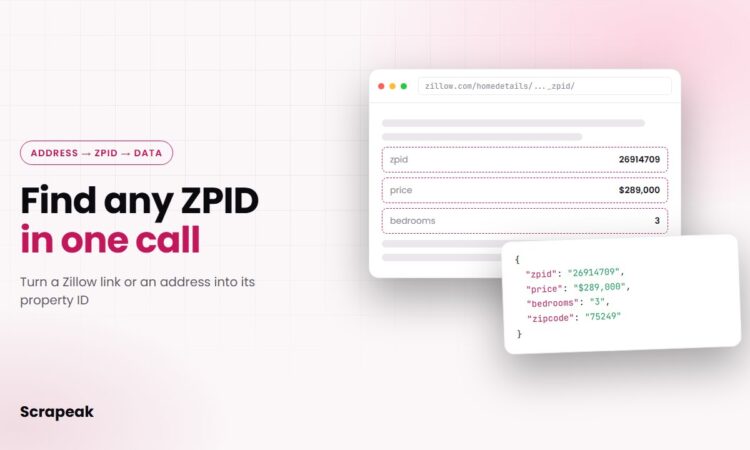
You have a Zillow link, or a list of addresses, and some tool or teammate is asking for the Zillow ZPID. The ZPID (Zillow Property ID) is the number Zillow gives each property in its database. It tells one home apart from every other home, so two houses on the same street with similar addresses still get different ZPIDs.
If you only browse homes on Zillow, you never need it. It matters when you save properties in a spreadsheet, match Zillow data to your own records, or scrape data through an API. The ZPID is a short, exact key that doesn’t depend on how someone typed the address.
If you already know you need ZPIDs for hundreds of homes, skip ahead or try our Zillow Scraper with 1,000 free credits, no credit card needed.
Where to find the Zillow ZPID in a URL
Every Zillow property page has the ZPID at the end of its URL, followed by _zpid:
https://www.zillow.com/homedetails/8320-Mountainview-Dr-Dallas-TX-75249/26914709_zpid/The ZPID here is 26914709. Copy the number before _zpid/ and leave the rest. For one or two homes this is the fastest way: open the listing, look at the address bar, copy the number.
How to get a ZPID from an address with an API
If you have a list of addresses instead of Zillow links, opening each one by hand gets old by the twentieth row. Our Zillow Scraper API has a /zpidByAddress endpoint for this. You send the street, city and state (the ZIP code is optional), and it returns the matching ZPIDs with their Zillow URLs.
import requests

params = {
    "api_key": "YOUR-API-KEY",
    "street": "3013 N Labarre Rd",
    "city": "Metairie",
    "state": "LA",
    "zipcode": "70002",
}

response = requests.get(
    "https://app.scrapeak.com/v1/scrapers/zillow/zpidByAddress",
    params=params,
)
print(response.text)
The response lists each match:
{
  "is_success": true,
  "data": [
    {
      "zpid": "103920781",
      "url": "https://www.zillow.com/homedetails/3013-N-Labarre-Rd-Metairie-LA-70002/103920781_zpid/"
    }
  ]
}
An address can return more than one result when nearby properties share part of it, so check the URL before you store the ZPID. With a spreadsheet of 300 owner addresses, a short loop over this call gives you a ZPID column in a few minutes.
Scraping ZPIDs from Zillow search results
When you scrape a Zillow search page, each result in the data carries its ZPID in the zpid field, next to a detailUrl that ends in the same number. Our /listing endpoint takes a Zillow search URL and returns these for every property on the page (usually about 40). To get the next page, raise the page number in the search URL you send.
So one search for a city or ZIP code turns into a list of ZPIDs, and that list is the input for the next step.
Need ZPIDs and property data for a whole market? The Zillow Scraper API returns ZPIDs from searches and addresses, then the full property record for each one. Try it free with 1,000 credits.
What you can extract with a ZPID
Once you have the ZPID, the /property endpoint returns the full property record: price, beds and baths, living area, listing status, contact details where Zillow shows them, and hundreds of other data points.
import requests

params = {"api_key": "YOUR-API-KEY", "zpid": "26914709"}
response = requests.get(
    "https://app.scrapeak.com/v1/scrapers/zillow/property",
    params=params,
)
print(response.text)
Each /property, /listing or /zpidByAddress call costs 10 credits, and only successful requests are charged. The free plan’s 1,000 credits cover about 100 calls, which is enough to test the whole flow on a real ZIP code. The Zillow Scraper docs list every parameter and a sample response.
A simple ZPID workflow for investors and analysts
- Send a Zillow search URL for a ZIP code to
/listingand collect the ZPIDs. - Call
/propertyfor each ZPID to get the full details. - Store the ZPID as the key in your sheet or database, so next week’s scrape updates the same rows instead of creating duplicates.
That third step is the one people skip. Addresses get typed three different ways (“St”, “Street”, “St.”), so matching on the address quietly creates duplicates. Matching on the ZPID doesn’t.
If you’d rather write the scraper yourself, our guide to scraping Zillow data with Python walks through it. Expect to deal with blocked requests once you go past a handful of pages, which is the part the API takes off your plate.
Zillow ZPID FAQ
Is the Zillow ZPID the same as the MLS number?
No. The MLS number comes from the listing service and belongs to one listing. The ZPID comes from Zillow and belongs to the property, which is why off-market homes that are not listed anywhere still have one.
Does every home on Zillow have a ZPID?
Every property page with a /homedetails/ URL has one. Some apartment buildings use a building page instead, and the units inside them have their own ZPIDs.
Can I search Zillow by ZPID?
Zillow’s search box is built for addresses, cities and ZIP codes. To get data for one ZPID or a few thousand, send them to the Scrapeak Zillow Scraper’s /property endpoint.
How do I scrape ZPIDs for a whole ZIP code?
Run a Zillow search for the ZIP code, copy the search URL and send it to the /listing endpoint. Each result comes back with its zpid, and you move to the next page by raising the page number in the URL.
Turn addresses into ZPIDs and full property data. Start free with 1,000 credits, or see the pricing plans for higher volume.