

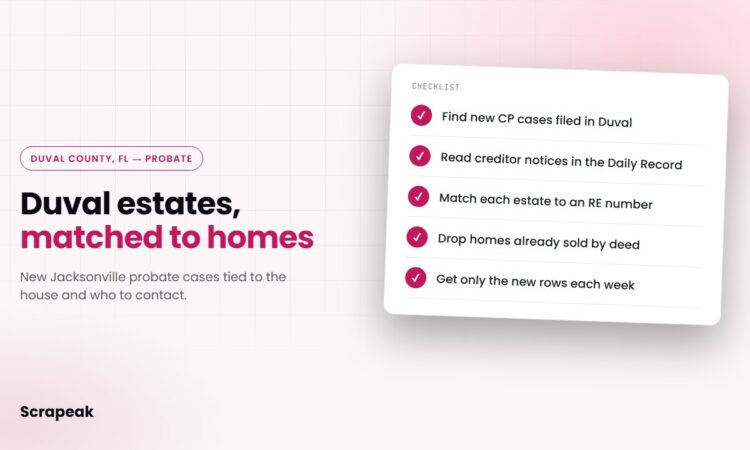
Type a name into the Duval County Clerk’s CORE portal and you get that person’s cases. What you can’t type is “every estate opened in Jacksonville this week.” That gap is why a Duval County probate records search turns into a weekly chore for anyone who sells to families handling an inherited house.
The people who ask us for this list in Duval are mostly HVAC and roofing contractors, real estate investors, estate cleanout crews and insurance agents. They all want the same few columns: the case, the personal representative, the house, and the attorney. They want them early, while the family is still deciding what to do with the property.
Duval has one quirk that helps. Jacksonville and Duval County consolidated their governments in 1968, so the Property Appraiser is a City of Jacksonville department and its records cover the whole county in one database (the beaches and Baldwin included). Matching an estate to a house only means checking one source.
Who uses Duval County probate records
HVAC, roofing and other home-service contractors
A house that sits closed through a Jacksonville summer usually needs its air conditioning looked at before anyone can show it. Heirs getting ready to sell also book roof checks, plumbing fixes, pest treatment and repainting. A contractor who knows the address and the representative’s mailing address can offer a pre-listing inspection before the buyer’s inspector finds the problems.
Real estate investors and wholesalers
Many heirs live out of state and don’t want to manage a house in Arlington or on the Westside from a distance. Florida gives creditors three months from the first published notice to file claims, so most estates stay open at least that long. That window gives an investor time to make a calm, fair offer instead of a rushed one.
Estate cleanout, junk removal and moving companies
Before an inherited home can be sold or rented, somebody has to empty it. Cleanout and moving crews use new cases to reach the representative while the contents are still in the house, which is usually the first job on the family’s list.
Insurance agencies
Once the owner dies, the house often has nobody living in it, and the existing homeowners policy may no longer fit. The representative may need vacant-property cover now, and the next owner (an heir, a landlord or a buyer) needs a new policy later. In Northeast Florida that conversation usually includes wind and flood questions, which gives a local agent a reason to call.
These are grieving families. Keep outreach brief and polite, check the federal and Florida do-not-call lists before you phone, and follow your licensing rules if you sell insurance or real estate. This is general information, not legal advice.
How probate works in Duval County
Duval estates go through the Probate Division of the Fourth Judicial Circuit, which covers Duval, Clay and Nassau counties (s. 26.021). Filings are handled at the Duval County Courthouse, 501 W. Adams Street in downtown Jacksonville, and the Clerk of the Circuit Court keeps the files at duvalclerk.com. Duval case numbers start with 16 and carry CP for probate, as in 16-2025-CP-.
| Florida rule | What it means for a lead list |
|---|---|
| Will deposited with the clerk within 10 days of learning of the death (s. 732.901) | Some wills show up at the clerk before any case is opened |
| Notice to creditors runs once a week for 2 weeks in a county newspaper (s. 733.2121) | The notice names the representative and attorney with addresses |
| Claims due 3 months after first publication, or 30 days after service on a known creditor (s. 733.702) | Most estates stay open at least three months |
| Summary administration when the non-exempt estate is $75,000 or less, or the death was over 2 years ago (s. 735.201) | Small estates can close fast, so check them the week they appear |
| Inventories and accountings are confidential (s. 733.604) | The court file won’t tell you the house or its value |
That last rule is the one people miss. The estate file tells you who died and who is in charge. It doesn’t list the property, so the property side has to come from somewhere else.
Want a few recent Duval estates already matched to homes? Ask us for a free sample.
Where Duval probate data lives online, and why scraping it is slow
The data you need for a probate lead sits in three places, and none of them will export “new estates this week” for you. A useful list means scraping each source and joining the records.
The Clerk’s CORE portal
CORE is where Duval dockets live. The public can look up cases, but the Clerk says full access to docket lines and images requires a registered account, set up by sending a notarized Registration Agreement to the CORE Registration Desk. The Clerk also runs a separate ePortal that shows less. On top of that, the Clerk’s website sits behind bot protection: when we tested it with plain automated requests, it answered with an Access Denied page. A scraper for CORE has to run slowly inside a logged-in session, step through filing dates or case numbers, and parse each docket for the events that matter (letters issued, notice published, a deed from the representative).
Older history is offline. Cases opened before 1977 are in archive books at the Probate Department, and the Clerk’s Official Records search online goes back to 1988.
Notices to creditors
The notice is the easiest record to extract, because Florida law requires it to list the decedent, the file number, the court’s address, the personal representative and the attorney, each with an address. In Duval, most of these notices run in the Jacksonville Daily Record, the county’s main publisher of legal notices, and Florida papers also post them to floridapublicnotices.com. Two catches: the same notice runs twice, a week apart, and the Daily Record also publishes for Clay, Nassau and St. Johns. A scraper has to deduplicate by case number and keep only Duval file numbers, or your list doubles and fills with estates from the wrong county.
The Duval County Property Appraiser
This is where an estate becomes a property lead. The Property Appraiser identifies every parcel by an RE number (formatted like 123456-0000) and its search tutorial asks for owner names as “smith john,” with no punctuation and a % wildcard when the first try misses. Court records write names their own way, so “John A. Smith Jr.” on a notice won’t match “SMITH JOHN A JR” on the tax roll unless the scraper normalizes both. The good news is that the office publishes monthly tax roll downloads in Access and TXT format, plus a sales file, so we can match against the full county roll instead of running thousands of one-at-a-time searches.
Doing this by hand works for five estates a month in one ZIP code. Across Duval, you end up with the same estate twice, Clay County notices mixed in, cases with no real estate at all, and homes that already sold by representative’s deed still sitting on your call list.
Automating a Duval County probate records search: fields, schedule and delivery
A clean probate feed has one row per estate, with the house matched and the contacts filled in. These are the fields we extract for Duval:
| Field | What it means |
|---|---|
| case_number | Florida uniform case number, 16-YYYY-CP-XXXXXX in Duval |
| filing_date | When the petition was filed |
| case_type | Formal or summary administration |
| decedent_name | The person who died, as written on the case |
| personal_representative | Who the court appointed to run the estate |
| representative_address | Mailing address from the notice, often outside Florida |
| attorney | Estate attorney named in the notice |
| notice_first_published | Date the three-month creditor window opened |
| re_number / property_address | Parcel matched from the Property Appraiser roll |
| assessed_value | Value from the appraiser’s tax roll |
| match_confidence | How sure the name-to-parcel match is (exact, likely, review) |
The match_confidence column is there because Jacksonville has a lot of common names. When a decedent’s name hits several parcels, we compare the middle initial, the last known address in the case and the owner’s mailing address, and flag anything we can’t settle for a human to check.
On schedule, we check new notices every few days, refresh open CORE cases once a week, and reload the Property Appraiser roll whenever the monthly file changes. Each run is compared with the last one, so you receive only new estates and changed rows (for example, a deed recorded by the representative, which means the house is sold and can come off your list).
Delivery goes wherever you work: a CSV in your inbox, a shared Google Sheet, an API endpoint, or files in S3, Dropbox or Google Drive, daily or weekly. Contractors often filter before the file reaches them, say single-family homes in 32207 and 32210 built before 1990. If you need phone numbers for representatives, our People Search scraper skip traces the same rows at 100 credits per search.
Build your own scraper or get a probate feed
You can build this yourself. The notice side is a weekend project for a developer who knows Python. The CORE side is harder: registered sessions, bot protection that blocks plain requests, and docket pages whose layout can change without warning. Then comes the name matching, which is where most home-built lists quietly go wrong.
Our rule of thumb: if you only work one or two ZIP codes and can spare an hour a week, a notepad and the Daily Record are enough. If you want all of Duval every week, with parcels matched and duplicates gone, a managed feed costs less than the time you’d spend keeping a scraper alive.
Scrapeak builds and maintains that feed. We handle the CORE sessions, the notice parsing, the Clerk’s site changes and the parcel matching, and you get the rows on your schedule. The same setup covers neighboring counties too, and we write about other Florida counties as well, like Palm Beach probate leads and the Orange County tax delinquent list.
Get a free sample of the Duval County probate list
Tell us the county and list you need and we’ll send you a free sample, usually the same day. After that we can deliver it daily or weekly as a CSV, Google Sheet or API. Built for investors, contractors, insurance agents and cleanout companies.
FAQ
Can I do a Duval County probate records search online for free?
Yes, for the basics. The Clerk’s CORE portal lets the public look up cases, and the Clerk says its court records search carries no fee. Parties who want every docket line and document image register for a CORE account with a notarized agreement. For cases opened before 1977, you search the archive books at the Probate Department in person.
Why doesn’t the Duval probate file show what the estate is worth?
Florida law (s. 733.604) makes estate inventories and accountings confidential, so the public file won’t list the house and its value. To learn what property an estate holds, you match the decedent to the Duval County Property Appraiser’s records, which list owner, RE number, address and assessed value.
Where are Duval County notices to creditors published?
Florida requires the notice to run once a week for two consecutive weeks in a newspaper published in the county. In Duval, the Jacksonville Daily Record publishes most legal notices, and Florida newspapers also post them on floridapublicnotices.com. Each notice names the personal representative and the estate attorney with their addresses.
Can roofing, HVAC or insurance companies use Duval County probate records?
Yes. The case number, representative and property address are public, and home-service contractors, insurance agents, cleanout crews and investors all use them to reach estates that are handling a house. Keep the first contact short and respectful, check do-not-call lists before phoning, and follow your own licensing and marketing rules.
Can you scrape Duval County probate records if the Clerk’s site blocks bots?
Yes, with care. We combine slow, logged-in collection from CORE with the creditor notices and the Property Appraiser’s monthly downloads, so the feed doesn’t depend on any one site staying open to automated traffic. You get only new or changed estates on each run, as a CSV, Google Sheet or API.