

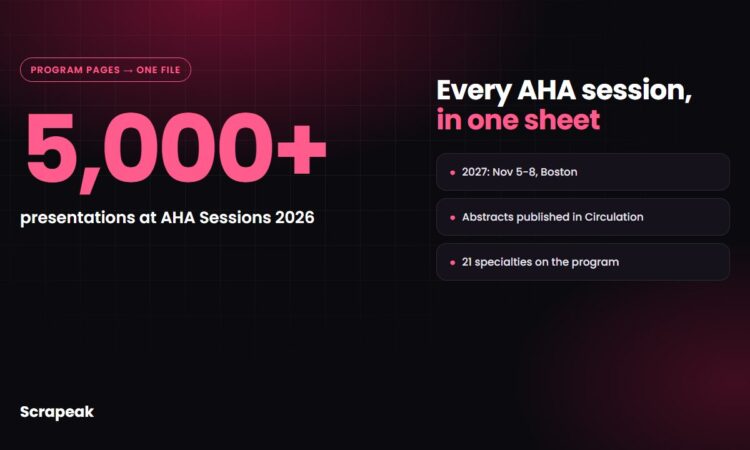
AHA Scientific Sessions 2027 runs November 5 to 8 in Boston, and by late summer someone on your team will ask for the program in a spreadsheet. The AHA Scientific Sessions abstracts and the session schedule are all public. They just live in different places: the abstract text in a Circulation supplement, the schedule in an online planner, and the late-breaking trials nowhere at all until the minute they are presented.
Here’s what AHA publishes and when, plus how a scraper pulls it into one file you can sort by day, room and topic.
What AHA Scientific Sessions publishes, and when
Scientific Sessions is the American Heart Association’s main yearly meeting. AHA’s official Scientific Sessions page describes the 2026 edition (Chicago, McCormick Place, November 6 to 9) as 5,000+ presentations across 21 specialties, with attendees from more than 100 countries.
The 2026 timeline is the best guide for 2027:
- Early June: deadline for general abstracts. Late-breaking basic science had a later window that closed in late August.
- November 2: abstracts from Scientific Sessions and the Resuscitation Science Symposium published as a Circulation supplement (Volume 154, Supplement 1), split into sections such as Arrhythmia, Imaging, Heart Failure and Cardiomyopathy, and Vascular Medicine.
- November 6 to 9: the meeting. Late-breaking science and featured science are embargoed until the date and time of the presentation.
One detail that trips people up: authors can opt out of publication when they submit. An opted-out abstract doesn’t appear in the supplement, the planner or the app, so your counts will never match the number of talks on the floor.
Planning for Boston 2027? Tell us which topics and fields you need, and we’ll send a free sample and a quote. Request a free sample
One team’s AHA spreadsheet, start to finish
Picture an events lead at a mid-size cardiac device company. Booth staffing for Boston is due in September, and the clinical team wants to know which days are heavy on heart failure and structural heart sessions. Marketing wants the same list to plan two evening receptions that don’t clash with the big rooms.
Last year they copied sessions from the planner into Excel by hand. It took two people most of a week, the times were in three formats, and half the rows had no topic tag because the planner shows topics on a different screen. When AHA moved a session, nobody noticed.
What they actually need is a dataset: one row per presentation, the same columns every time, refreshed automatically as the program fills in. That’s a standard scraping job.
Where AHA Scientific Sessions abstracts live online
There are three public sources, and a useful file joins two of them.
The Online Program Planner is the schedule. For 2026 it was hosted on a third-party meeting platform linked from the AHA site. You can browse the full program, featured and late-breaking sessions, and abstract sessions filtered by type: Abstract Oral Session, Abstract Poster Board Session and Moderated Digital Poster Session. Sessions can be searched by day, session type, community or speaker. The planner is built with JavaScript, so viewing the page source shows almost nothing.
The Circulation supplement holds the abstract text, grouped by topic section. It is the better source for titles, authors and full text, and the weaker one for when and where something is presented.
The mobile meeting app is handy on the floor and lets attendees read post-embargo abstracts, but it has no export. We leave it alone and stick to the public web pages.
How we scrape the AHA program into one spreadsheet
A scraper does the clicking for you and writes the same columns on every run. For AHA the build usually goes like this:
- Read the planner’s data, not its screen. The planner loads sessions through background requests. Reading those responses is faster and breaks less often than rendering every page in a headless browser, so that is where we start.
- Write one row per presentation. Session details (title, type, date, time, room) are captured once and copied onto each talk or poster inside that session. Breaks, Q&A slots and industry-sponsored events get their own tag so you can filter them out.
- Join the abstract text. When the Circulation supplement goes live, each planner row is matched to its abstract. Until then the text column stays empty and the row is marked “title only.”
- Clean dates and times. Every time gets an ISO date and an explicit time zone (Boston is Eastern Time), so the file sorts correctly in Excel and imports cleanly into a calendar or CRM.
- Re-run on a schedule. Weekly while the program is filling in, daily in the last two weeks, and every morning during the meeting to catch room changes and late-breaking slots. Each run flags what was added, moved or removed since the last one.
If your team already has a list of abstract DOIs from the supplement, the same metadata can come straight from the DOI records. Our DOI scraper guide explains how that works.
Fields you get for each session and abstract
Here is a typical column set. You can drop anything you don’t need.
| Field | Example (sample value) | Source |
|---|---|---|
| session_title | Advances in Heart Failure Devices | Planner |
| session_type | Moderated Digital Poster | Planner |
| community / topic | Heart Failure and Cardiomyopathy | Planner, supplement |
| date, start_time, end_time | 2027-11-06, 10:30, 11:45 ET | Planner |
| room | Hall B, Poster Area 3 | Planner |
| abstract_number | 4100123 | Planner, supplement |
| presentation_title | Sample title of an accepted abstract | Both |
| authors, affiliations | As printed on the abstract | Supplement |
| abstract_text, doi | Full text and link once published | Supplement |
| status | title only / published / changed | Added by us |
The status column saves the most time. It shows which rows changed since the last run, so nobody has to compare two spreadsheets by eye.
Don’t want to copy 5,000 sessions by hand? We’ll build the AHA scraper, test it on last year’s program and send you a sample file first. Get a quote
What gets in the way when scraping a congress program
Timing. For months your file can only hold titles and slots. The abstract text lands days before the meeting, and late-breaking results only appear when they are presented. A scraper that runs once in October gives you an incomplete file, which is why the schedule matters more than the first run.
Program changes. Sessions move rooms, speakers swap and posters get withdrawn. Change tracking catches these, and we keep removed rows in the file with a “removed” status instead of deleting them, so you can see what happened.
Bot protection. Journal sites often run bot checks. We keep request rates low, cache what doesn’t change, and use DOI metadata where it gives the same fields. We don’t log in to anything and we don’t collect content that is behind a paywall or an account.
Missing rows. Opted-out abstracts and embargoed trials mean the planner, the supplement and the room signs never agree perfectly. The file tells you which source each row came from, so the gaps are visible instead of surprising.
Our post on medical conference data covers the same problems across other congresses, and the ESMO guide shows how a European program differs.
Delivery, cost and a note on privacy
You get the data as CSV, Excel-ready files, JSON or a Google Sheet, delivered by email, Google Drive, Dropbox, S3, FTP or API. Simple scrapers are usually ready in 2 to 3 days. Price depends on how many sources we join and how often it runs, so a one-off program export costs less than a daily feed through the meeting. See pricing for how we quote.
The data is public scientific program information. No patient data is involved. AHA draws authors from more than 100 countries, so if your file includes names of researchers based in Europe, GDPR applies to how you store and use them: keep only the fields you need and have a clear reason for using them. We can leave author names out entirely if your use case doesn’t need them.
FAQ
When are AHA Scientific Sessions abstracts published?
For 2026, the abstracts appeared in a Circulation supplement dated November 2, a few days before the meeting opened in Chicago on November 6. Late-breaking science stays embargoed until the moment it is presented, so those results arrive during the meeting itself.
Where can I find AHA Scientific Sessions abstracts?
In three places: the Circulation supplement on ahajournals.org, the Online Program Planner linked from the Scientific Sessions page, and the AHA conferences mobile app. The supplement has the text, the planner has the schedule.
Can I download the whole AHA program as Excel?
Not from AHA. The planner lets you build a personal schedule, but it has no full-program export. A scraper collects every session and abstract and writes them to CSV, Excel or Google Sheets.
Is it legal to scrape a medical conference program?
The program and abstracts are published openly, but terms of use and local law vary, so check the site terms and ask a lawyer if you are unsure. We only collect public pages, skip anything behind a login, and never touch patient data.
When is AHA Scientific Sessions 2027?
AHA lists November 5 to 8, 2027, in Boston, Massachusetts. Abstract deadlines for 2027 had not been posted when we checked.
Want the AHA Scientific Sessions program as a dataset? Tell us the topics, fields and delivery format you need. We’ll build a sample from the public program and send it with a quote, usually within a couple of days. Request your free sample